
Postal service websites need to provide quick and reliable access to essential services, from tracking deliveries and finding local branches to purchasing postage and managing mail. Users may be accessing these sites on a variety of devices and network connections, often while on the move.
In recent years, many of these services have focused on expanding their digital platforms, offering discounts for customers who opt to use their online services rather than do their business in store. With this shift in business strategy in mind, it's more important than ever that these websites are fast.
To better understand how these websites perform, we analyzed 25 national postal service websites from countries across Europe. We wanted to identify which postal websites deliver the fastest user experience and explore the factors that distinguish the best-performing sites from the rest.
What we analyzed
Our analysis is based on real-world usage data collected by Google from Chrome users who visit these websites. This dataset, known as the Chrome User Experience Report (CrUX), provides insights into the actual experience of site visitors rather than simulated test results.
We reviewed all three Core Web Vitals metrics for each post office's homepage:
- Largest Contentful Paint (LCP): measures page loading performance
- Interaction to Next Paint (INP): measures responsiveness to user interactions
- Cumulative Layout Shift (CLS): measures visual stability during page load
Let's take a look at the European ranking.
European Post Office Website Page Speed Rankings
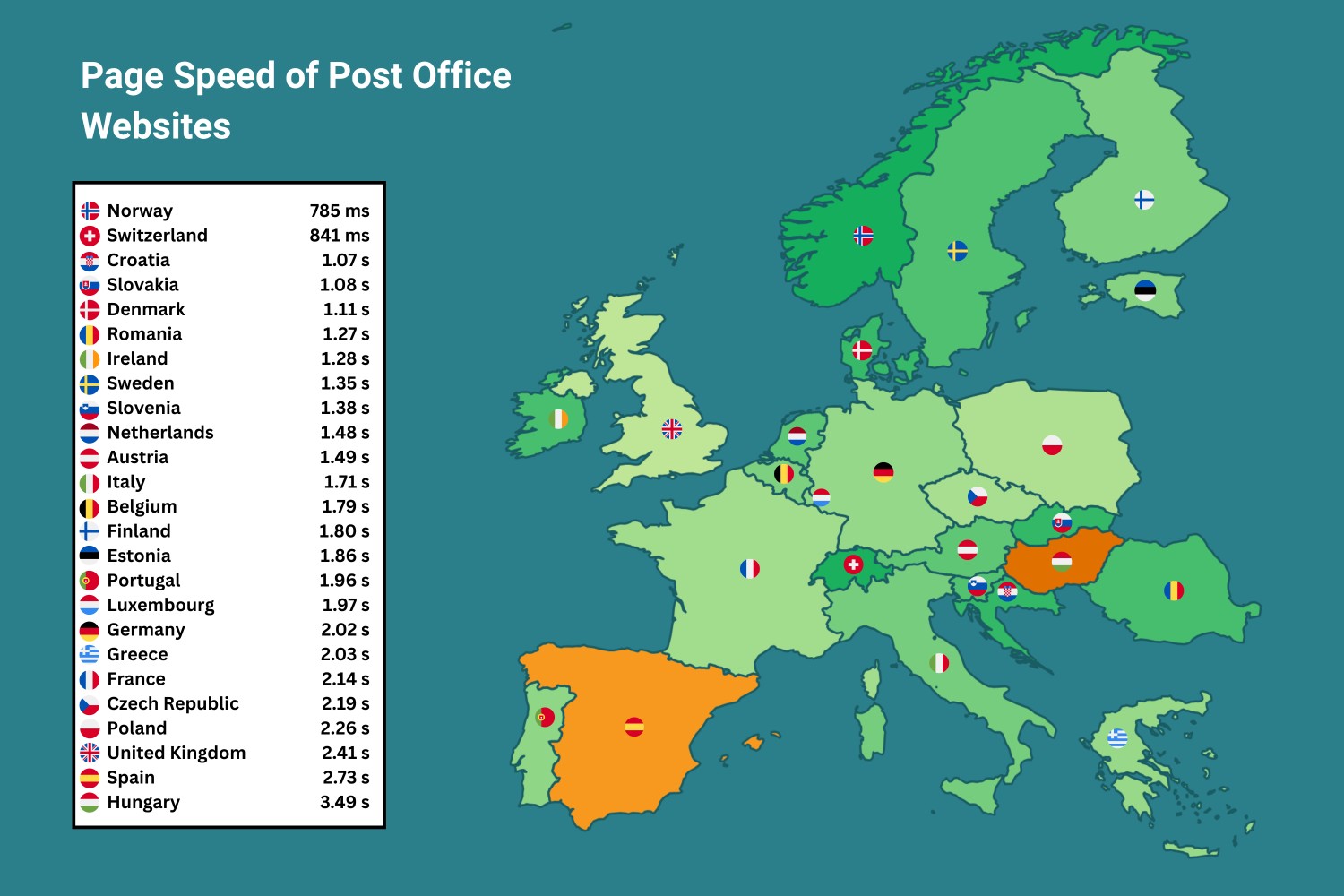
The map below shows impressive results across Europe. The two standouts are Norway's posten.no and Switzerland's post.ch, both with LCP scores under 1 second. Seventeen of the websites tested scored under 2 seconds, well within the good score range of 2.5 seconds.
In fact, only two websites placed in the needs improvement range of 2.5 seconds to 4 seconds: Spain's correos.es with a score of 2.73 seconds and Hungary's posta.hu with a score of 3.49 seconds.
Check out the full benchmark results.
Top 10 Post Office Websites
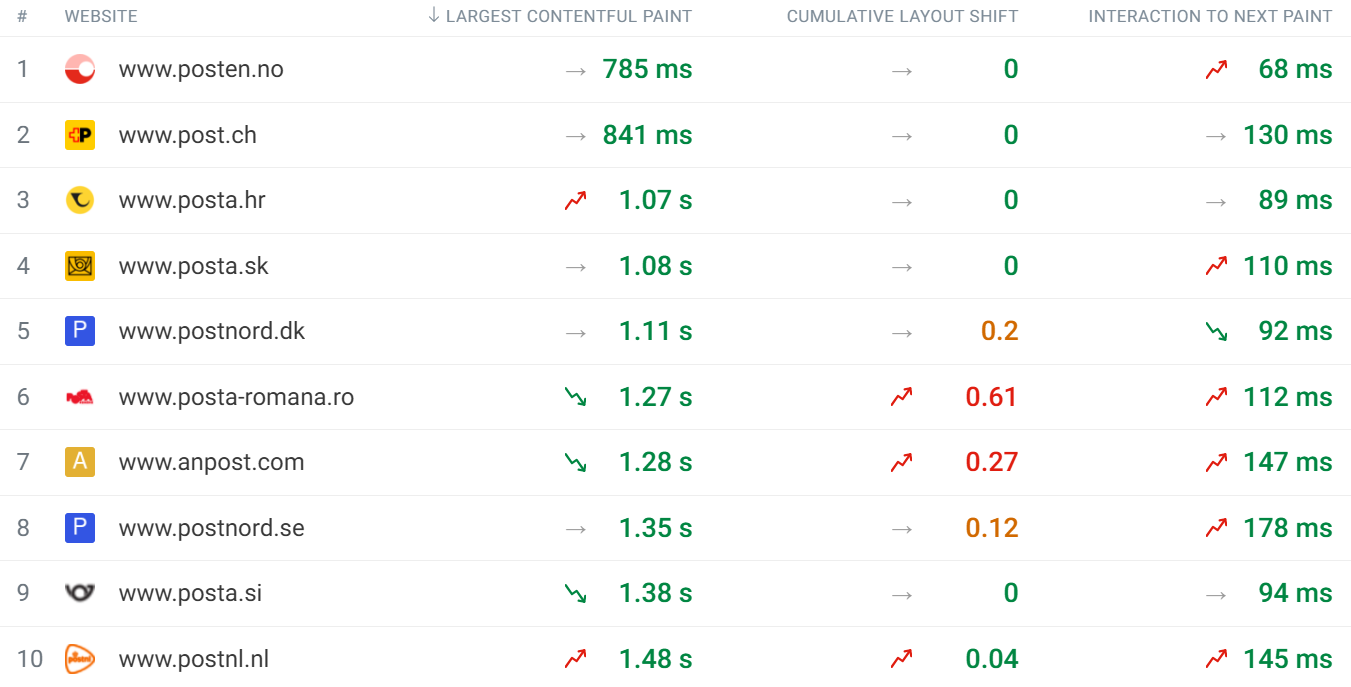
Taking a look at the CrUX ranking table, we can see scores for all of the Core Web Vitals metrics. Not only does Norway top the LCP ranking, but their CLS and INP scores are both easily in the good range. All of the top 10 websites have good INP scores of under 200 ms, with four websites far exceeding this target with an INP score of under 100 ms.
When looking at CLS, four of the websites have scores outside of the good range. Romania's posta-romana.ro has the worst CLS, with a score of 0.61.
Bottom 10 Post Office Websites
Looking at the bottom ten websites in our ranking, we can see a similar trend.
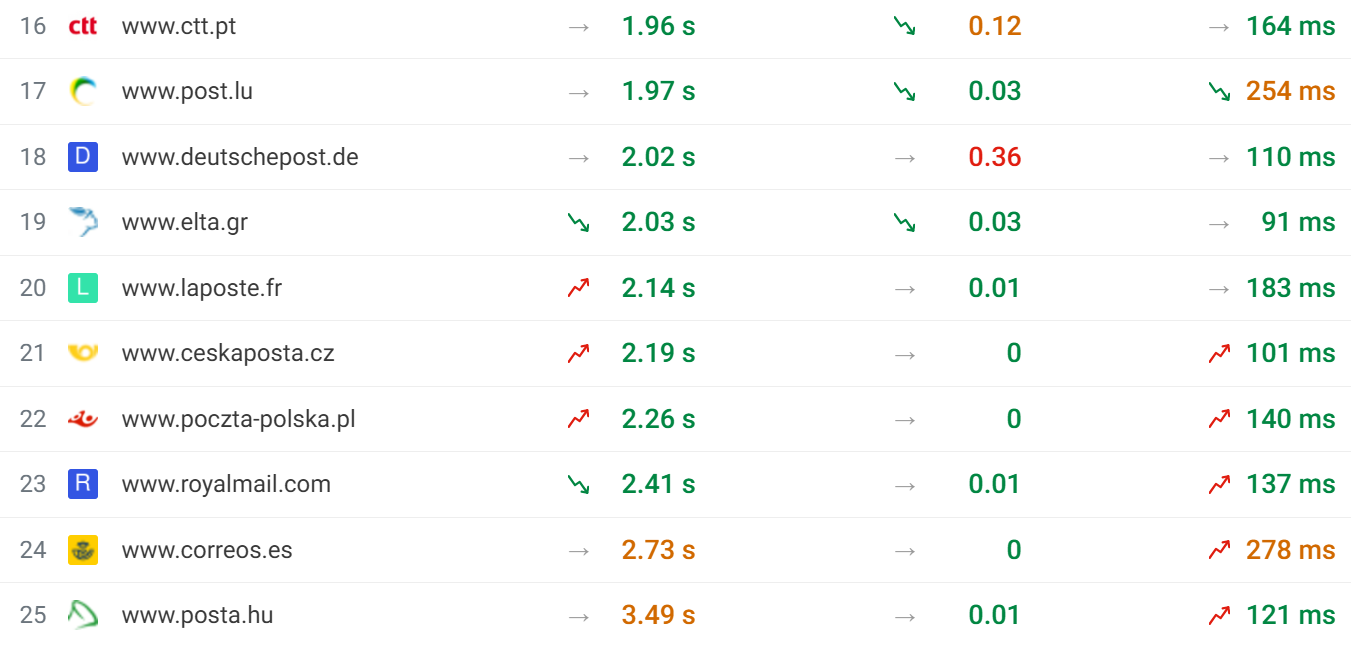
The standout result here is Spain's correos.es, which we know already needs to make LCP improvements. Their INP score is 278 ms, meaning their website is not only slow to render main content on the page but also slow with interactions.
In contrast, Hungary's posta.hu has an INP score of 121 ms, placing them comfortably in the good range despite their LCP being in the needs improvement range.
Why does Norway have the fastest website?
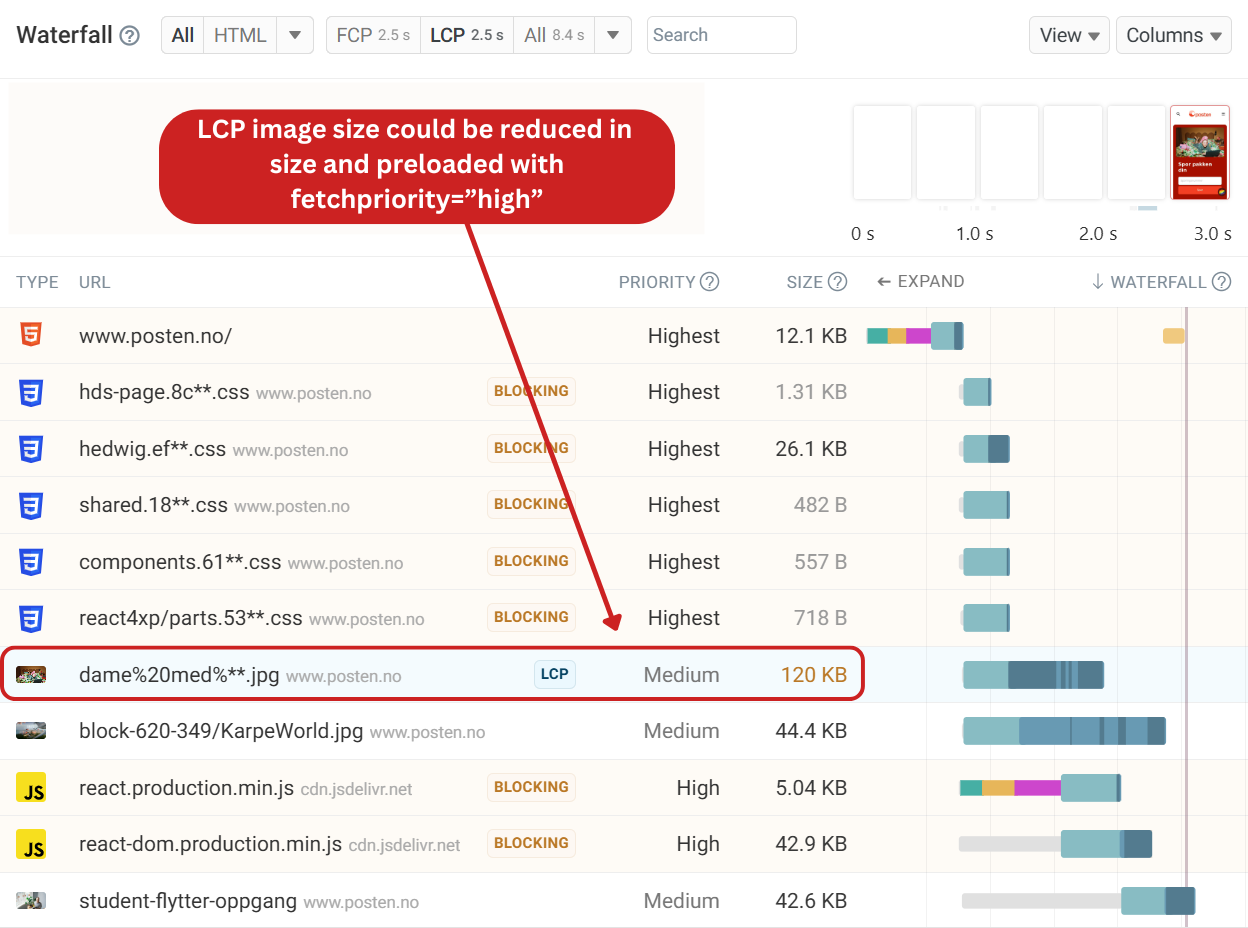
Norway's posten.no is a clear winner according to our rankings, with excellent scores across all three Core Web Vitals metrics. Their success starts with an impressive Time To First Byte (TTFB) score of 428 ms. This is a fast server response time to the initial request. Pairing the fast TTFB with using server-side rendering for a small HTML document size allows the content to be displayed quickly on the page for the user.
While the results are impressive with just a few small render-blocking requests finishing quickly, there are still some optimization opportunities when reviewing the request waterfall. The LCP image is 120 kb. This could be switched for a modern image format with a smaller size, making downloading the resource faster.
Why do Spain and Hungary perform the worst?
As we mentioned earlier, Spain and Hungary are the only two websites outside of the good range for the Largest Contentful Paint metric. Let's take a look at each website individually to see why they are currently unable to achieve a good score.
Correos.es
Spain's correos.es has a good TTFB CrUX score of 453 ms. The main issue that is holding the page back is hiding content through CSS, which we picked up in our lab test. This technique is mainly used for A/B testing or design decisions. In this situation, the CSS is hurting the First Contentful Paint (FCP) score, resulting in visitors viewing content on the page much later than they should.
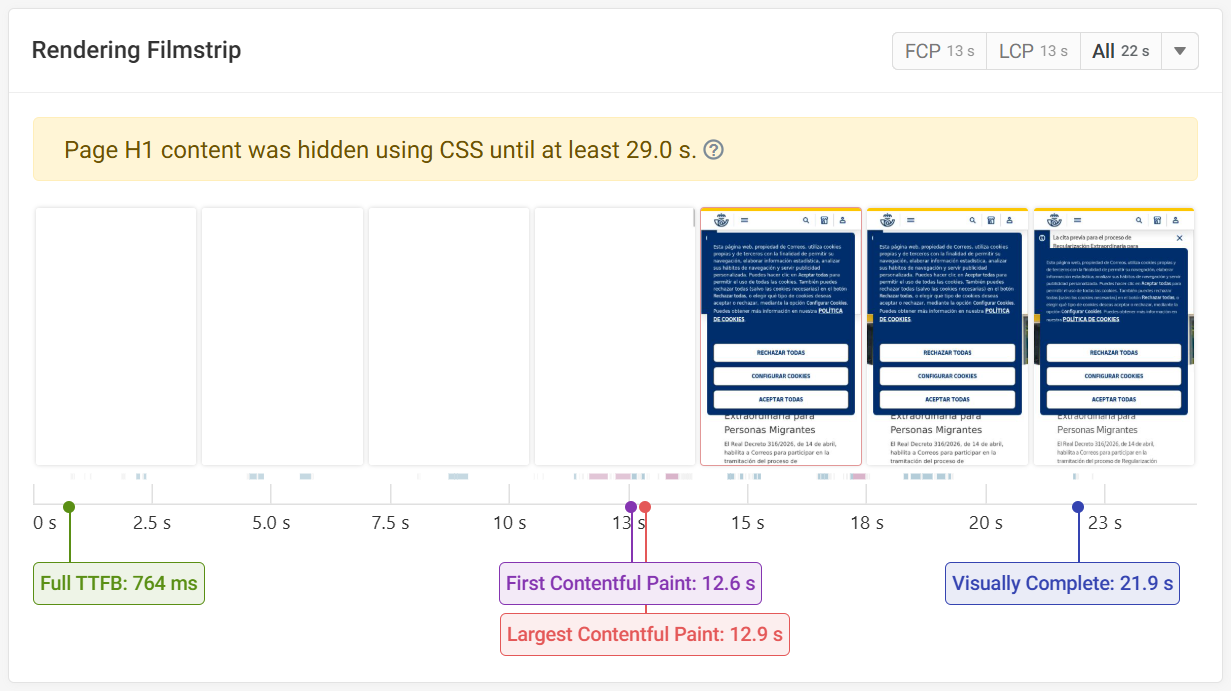
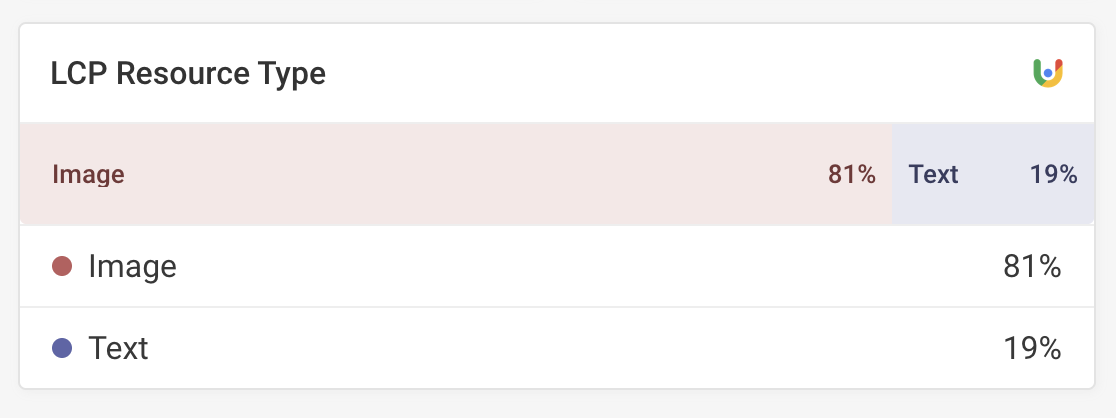
For 81% of visitors, the LCP element is a background image. This image is discovered late in the page load, as heavier images are given higher priority by Chrome.
Since we know this is the only image which appears above the fold, this image could be preloaded with fetchpriority="high". The image is already referenced in the HTML document itself, so there is no request chain involving a CSS file.
One positive is the use of the back/forward cache. With 24% of visitors navigating between pages while this cache is enabled, page transitions feel significantly faster, contributing to a smoother overall browsing experience.
Posta.hu
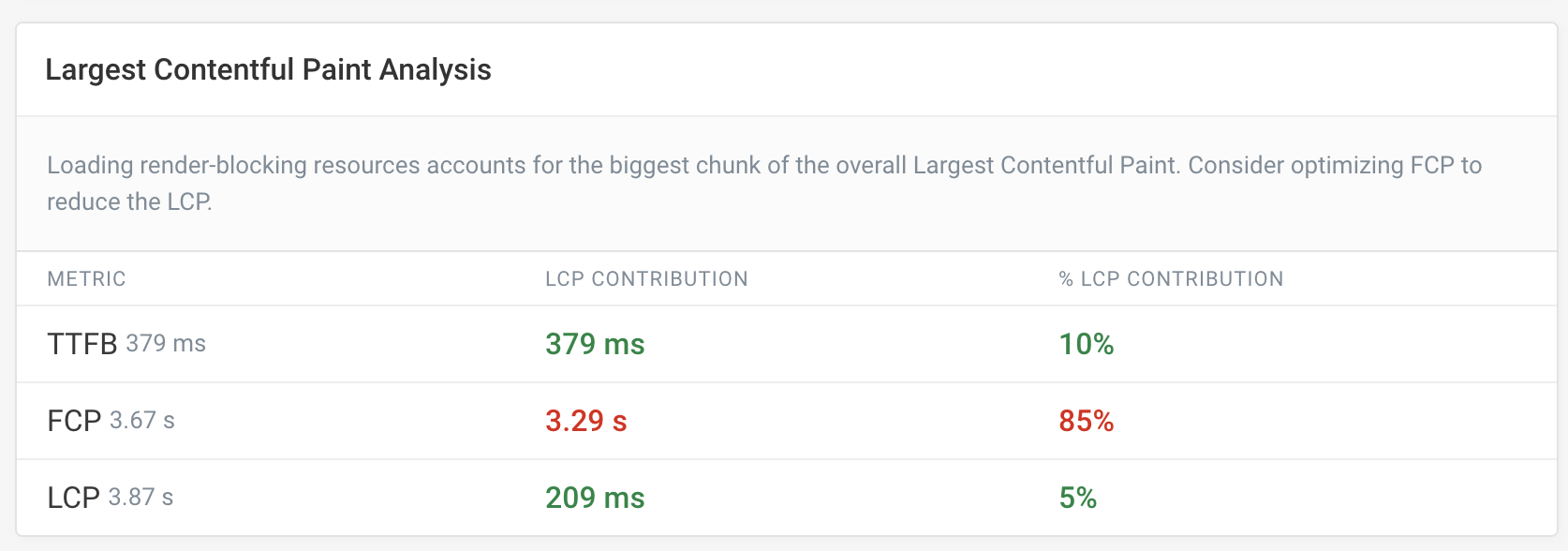
Hungary's posta.hu ranks at the bottom of our list with an LCP score of 3.49 seconds. Reviewing the lab test and looking further into the data, we can see directly where their issues lie. They have a CrUX TTFB of 371 ms, which is faster than posten.no's score of 428 ms.
However, the First Contentful Paint only happens after a further 3.3 second delay.
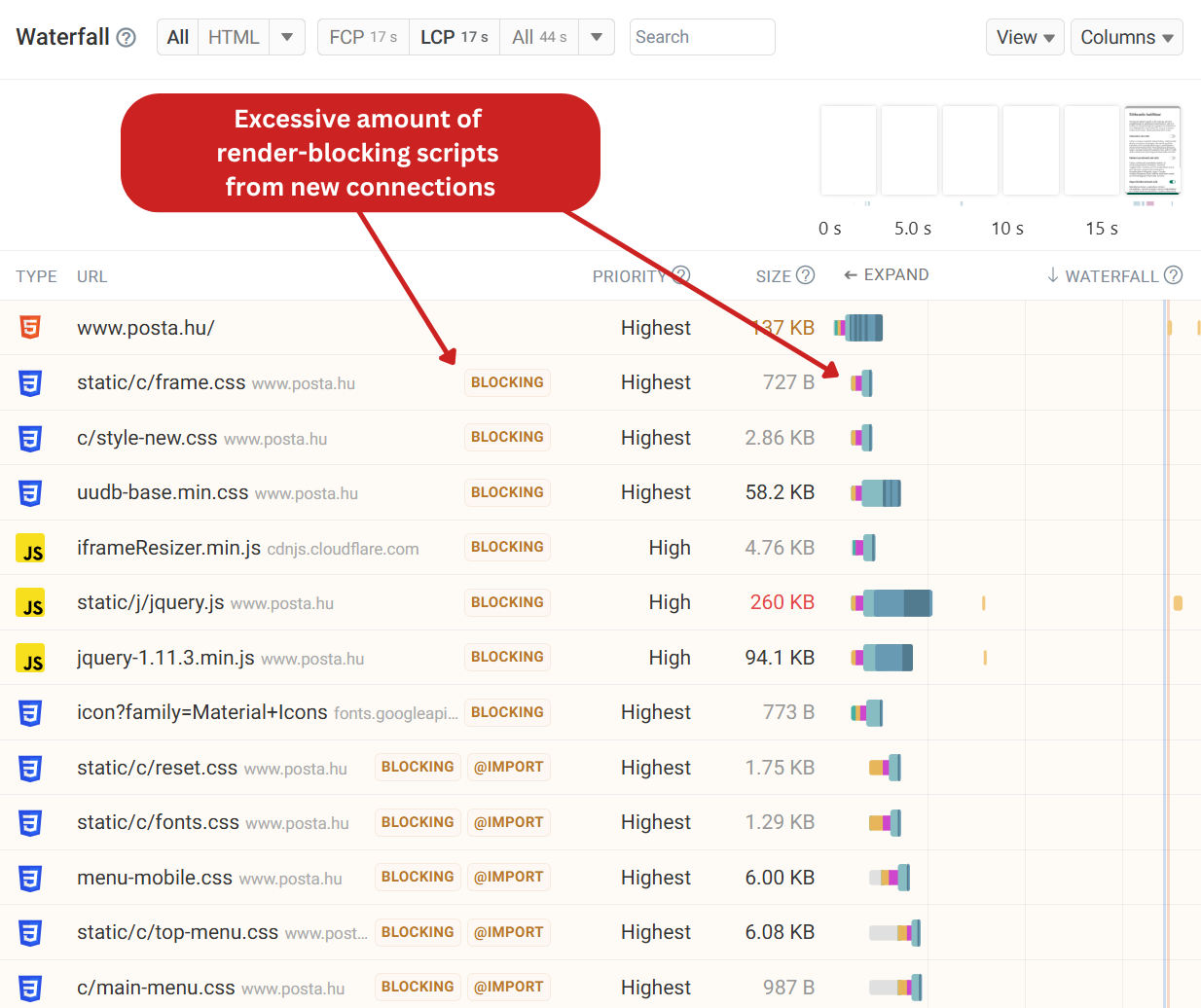
The main cause of this delay becomes obvious when we view the request waterfall. There are 48 render-blocking requests. The website also doesn't support the newer HTTP/2 protocol, which means several server connections need to be established and the browser then delays other requests until they are available again.
The excessive number of render-blocking requests adds a significant delay, with each request taking longer to complete than the previous. One of these requests is a JavaScript file that is 741 kb in size and is discovered late, adding even further delays for content to be rendered.
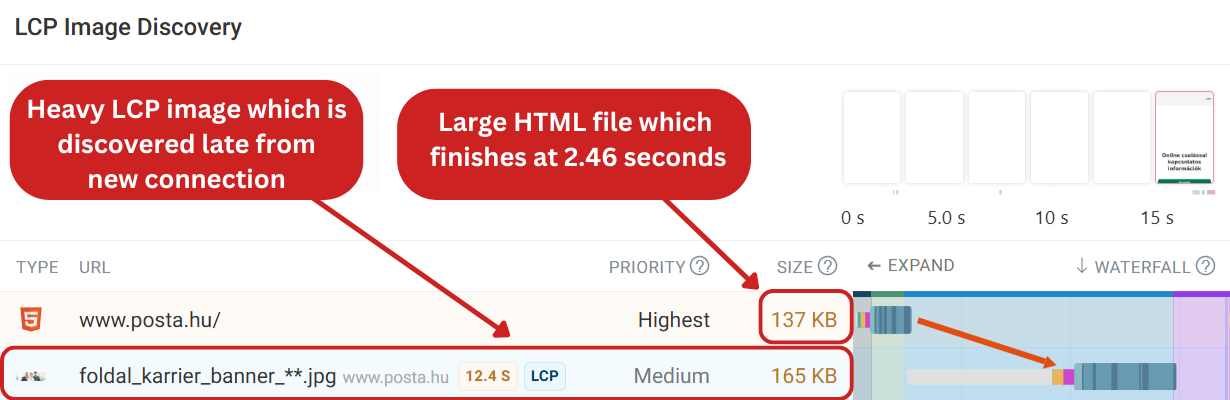
Aside from the excessive render-blocking scripts, there are other improvements to be made. When looking at the LCP image discovery waterfall, we can see the HTML request is larger than what we typically see.
Focusing on the LCP image itself, the image is 165 kb. Switching to a modern image format that is preloaded would be more optimal, as well as serving the image from the HTML document rather than from a new connection.
Conclusion
Norway's posten.no stands out as the clear winner, delivering excellent performance across all three Core Web Vitals. With only two websites falling outside the good LCP range, European postal services are generally performing well, meaning that customers who are looking to take advantage of online discounts generally won't have a slow experience.
For the slower websites, following common best practices can lead to significant improvements. Optimizing LCP images with modern formats and preloading, reducing render-blocking resources would contribute to faster load times. Hungary's posta.hu stands out as the website which needs the most work. Given their quick TTFB, addressing the excessive render-blocking requests would make a significant impact.
To test your website, try our free website speed test or start monitoring your Core Web Vitals with a 14-day free trial.
Monitor Page Speed & Core Web Vitals
DebugBear monitoring includes:
- In-depth Page Speed Reports
- Automated Recommendations
- Real User Analytics Data