
What can you do to help customers find your website when looking for products online? In this comprehensive guide, we will explore the key strategies and best practices to optimize your ecommerce website for search engines in 2026.
1. Ecommerce SEO in 2026
SEO is the discipline responsible for preparing web pages so that they are aligned with what users are looking for in search engines and can be an eligible option in search results.
The acronym "SEO" refers to its strict definition: search engine optimization. Actions aimed at increasing visibility in rankings in the subject areas covered by a web page.
The transition from search engine to answer engine
In 2026, we no longer think only of classic search engines such as Google or Bing, but the emergence of Generative Artificial Intelligence makes us consider other platforms that are now disrupting users' search habits: ChatGPT, Perplexity, Claude, among others.
The transition from search engines to response engines is still in its early stages, as the adoption of these platforms is still gradual and not all sectors use them in the same way.
Classic search engines and LLMs use the same content from your website. Keep in mind that if you take risky actions to try to influence ChatGPT, you could indirectly be harming your visibility on Google. Now is the time to be very strategic and understand what to do in the short, medium, and long term.
SEO Everywhere
On the other hand, SEO projects also require a greater understanding of our target audience's habits than ever before.
- Do they use search engines exclusively?
- Do they also integrate searches on social platforms such as TikTok, Instagram, or YouTube?
- Do they focus on AI responses?
It is precisely from these phenomena that the concept of Search Everywhere Optimization arises.
Organic visibility is no longer exclusive to Google, but rather the content of a website or various digital assets can be worked on to be positioned on different platforms.
The important thing is to be clear that each platform will have rules or ranking factors that we must study and implement to maximize the visibility of our projects.
In addition, it will also be key to understand the customer journey of potential customers or buyers. With the new developments mentioned above, this journey is being redefined, and we must consider what influences these steps or interactions. For example:
- What prior knowledge of the product do our customers have?
- What is their digital culture?
- What are their technical skills?
- What is their level of adoption of the latest trends?
In these aspects, demographic factors can be crucial. Studying and understanding them can give us clues as to how to focus our strategies.
SEO vs PPC vs Merchant
Finally, it is worth mentioning another phenomenon that is happening and will continue to happen: integrations. Whether in Google or the rest of the search ecosystem, there are opportunities that synergize with SEO, for example:
- Google: combined strategies through Google Merchant
- Google: universal commerce protocol (UCP)
- ChatGPT: direct integrations that allow you to buy from the responses
Therefore, SEO applied to e-commerce in 2026 continues to draw on the classic fundamentals but must emphasize understanding how to distribute efforts and where to put resources, based on where the target users are and keeping conversion in mind at all times.
If you needed a sign to start synergy projects with paid teams, this is it. It's time to work together.
2. Keyword research
Keyword research is the process by which we discover and analyze which words users use to search for information or products.
Through this type of analysis, we create the basis for an SEO strategy, as it allows us to understand users' search patterns, enabling us to do something very important:
"Align what users expect to find in their search with the content we have to offer them and satisfy their explicit and implicit needs."
Search volume vs Search Intent
From this perspective, we must first explore the concept of search intent. We must take into account the different types of searches that exist and the motivation behind each one:
- Navigation searches: those related to a specific brand or website, are searches intended to land on a specific site or brand and navigate through it. Therefore, despite being searched, they could even be considered similar to direct traffic. Example: "Nike offers".
- Information searches: those aimed at finding general information, content or information without any component that reflects taking any action, only satisfying a direct need for information. Example: "differences between...".
- Commercial or research searches: those whose objective is to research and compare brands, as an action that precedes the decision-making process prior to the final conversion. Example: "best", "comparison", "vs".
- Transaction searches: those intended to perform an action. In the case of e-commerce, these may be searches that describe products or include patterns that allow us to infer that a purchase will take place. Example: "buy...", "price...", "SKU".
- Location searches: searches that have a local component or that implicitly reveal a physical or local need. Example: "Nike Oregon", "opening hours...", "shop...".
It should be noted that this type of analysis is usually carried out in different situations:
- When the shop does not yet exist and it is necessary to identify what page structure it needs.
- When the shop already exists and you want to review what improvements can be made: optimizing what already exists and creating what is not yet covered, expanding the web architecture.
- When you want to evaluate the international expansion of the shop into other markets. In these cases, keyword research is always done considering the market and language, and you will need to do as many as the project has markets and languages.
- When you want to develop a content strategy.
Actionable advice: keyword research remains a crucial activity that combines market research and user research. Do not try to completely automate (or delegate) a key task, nor use tools that do not have all the information (e.g. LLMs).
Keyword research process
With regard to the keyword research process, there may be different nuances depending on the project involved. However, in my experience, these are the usual steps in e-commerce projects:
- Review of the product catalog. At this point, the objective is to take inventory of the products we always have and try to identify which search can be assigned not only to the product itself, but also to the product group or listing.
- Review of product attributes and characteristics. This is one of the keys to e-commerce: breaking down the products as much as possible and having a table of characteristics will allow us to delve deeper into the potential ways in which they can be searched for, which will be very useful for categorization.
- Review potential categorizations beyond products. This refers to other classification criteria, for example, whether we sell our own brand or third-party brands, whether we have seasonal campaigns (Black Friday, Christmas, sales), whether there are key searches related to how to buy, for example, buying guides, FAQs, etc.
- Review competitors and sector. At this point, we can greatly expand the potential of the project because opportunities will arise to expand the product catalog if there is clear potential or demand, although this will not always be commercially feasible.
- Extract related suggestions or keywords. In case we have forgotten something in the initial part of the process, it is always advisable to use tools that generate word suggestions.
- Categorization or clustering of the words obtained. Once we have our keyword matrix, we can try to group them by common characteristics. If we have created our attributes table, this already constitutes a starting classification focused on the catalog.
- SERP analysis. Once we have the list of potential words and a basic categorization, we can analyze which players are ranking globally and for each category. This gives us an overview of who we are competing with in each attribute or category. This analysis will also provide us with important information: which formats appear most globally and by category. Images? Videos? Local packs? User questions? With this, we can calculate our own visibility metrics.
- Identification of gaps. Next, we will need to see what already exists and what does not exist as a page to position. These will be potential candidates to be created as categories or if we are able to obtain new products.
Some considerations of the process that allow us to customize the analysis depending on the resources and type of project we have:
- When our e-commerce has a stable product, the catalog is usually fixed or semi-fixed for most of the year. But sometimes, we work with catalogs that change seasonally (autumn, spring, summer), and that means doing research before each catalog changes. The same applies when categories are expanded or new products are introduced; we will have to analyze the organic approach based on user searches.
- We can use many types of tools. There are complete suites (SISTRIX, Semrush, or Ahrefs), and we can also use API services (DataforSEO, Rapid API, Keyword Tool, etc.), but we should add other ways of discovering ideas that are closer to users' mental models. For example, we can use forums or communities (Reddit, Quora, etc.), as well as visual and video platforms (Pinterest, Instagram, or TikTok).
- Given the multi-platform and conversational nature that SEO has acquired, there are other ways of understanding the product through use cases, pain points that they solve, and other similar aspects, which we can extract from call centers or customer service centers, if the project has them, and also from reviews on Google, Yelp, and other services where objections can be identified.
- Let us not forget to use demand data, not only from Google, but also from those platforms likely to be used by our target audience (Instagram, YouTube, Facebook, or TikTok). We need not only search volumes, but also search intent and whether there are differences in demand in different months of the year. Let's consider that the information will never be exact and, in some cases, will not exist (as in the case of ChatGPT and other LLMs).
- Let's not forget that, when it comes to AIs and LLMs, there is no information on public prompts made by users, so we will have to incorporate the concept of "synthetic prompt" or "potential prompt" to try to simulate what the user would write. However, whenever possible, it is always a good idea to incorporate criteria from the discipline of UX and its user research, to survey users, conduct focus groups, or try to offer incentives to gain in-depth knowledge of their search, research, or decision criteria.
Adapt the process to your specific case. If you can achieve SEO+UX synergy, it will always be positive. Automate the tedious parts, but do not delegate decision-making, as this could lead to future quality issues.
3. Site architecture
Architecture refers to how a website's content is organized so that humans can easily navigate it and search engines and LLMs can crawl or access the content to consider it in their subsequent phases of operation (rendering, indexing, classification, or eligibility).
These are the processes of organization, tagging, search, and navigation systems of the website, geared towards usability, findability, and understanding.
Architecture is about getting to know users and providing them with the most relevant content where they expect to find it with as few clicks as possible.
For search engines and LLMs, an optimized site architecture helps web crawlers find and index all pages on the website and other key points:
- Crawling and indexing
- UX improvements
- Reduced bounce rates
- Authority transfer
- Prevention of cannibalization
Let us also consider that:
- There is always more than one way to organize content.
- People have different needs and different levels of knowledge about a topic.
- Technology is constantly changing.
- Search engines are constantly changing.
Product Inventory and Categorization
We begin by mentioning the concept of minimum content unit, that is, any piece of content that is present in an e-commerce site and whose appearance is always consistent is the basis of the architecture.
Therefore, the architecture is defined based on the current and, if possible, future "catalog" of pieces. In this way, we use the products as a "catalog" to categorize them.
From here on, the architecture is based on:
- Organization systems: how each piece of content is categorized.
- Labeling systems: what name we use to represent the information.
- Navigation systems: how we make it easy for users to move around the information.
- Search systems: how the information is searched for.
The important thing here is to focus on organizational systems. Depending on the complexity of the project and the needs to be met, we have different options that can be used individually or in combination:
- Organization by date or time: an example of this could be a blog file with posts classified by year and month.
- Alphabetical organization: examples of this could be old telephone directories classified in alphabetical order or a shop's list of brands, which allows you to choose by initial.
- Organization by location or geographical point: quite common in classifieds and verticals, which target their product by province, for example job offers or second-hand cars, but in e-commerce, if we have a store locator, we can work with this type of organization.
- Organization by topic: this criterion is one of the most widespread as it uses the inherent nature of the content, for example a sports e-commerce site will have product type as one of its criteria.
- Organization by target users: this is also a widespread criterion. The architecture can be developed by focusing on target users, for example, women's or men's products, which are differentiated from the outset.
- Organization by attributes or facets: very common in e-commerce filters, to develop multi-level categorizations using product characteristics such as size, color, material, etc.
- Organization by a combination of the above.
The main challenges we face here are:
- The organizational criteria depend on the minimum number of units. We cannot create categories with a single product, for example, we must establish a minimum number of products in order to avoid incurring massive thin content.
- Business priorities (margins, trends, ROI) and SEO keyword research will help emphasize which pages are most important in the architecture.
- There are independent organizational silos, but these silos often overlap, and we must choose how to deal with them in the architecture and in the generation of URLs. We must also consider whether the CMS we use allows us to do this or whether we need to develop a custom solution, which entails additional costs, time, etc.
- From SEO keyword research, we have always been able to infer characteristics, for example in tools based on autosuggest:
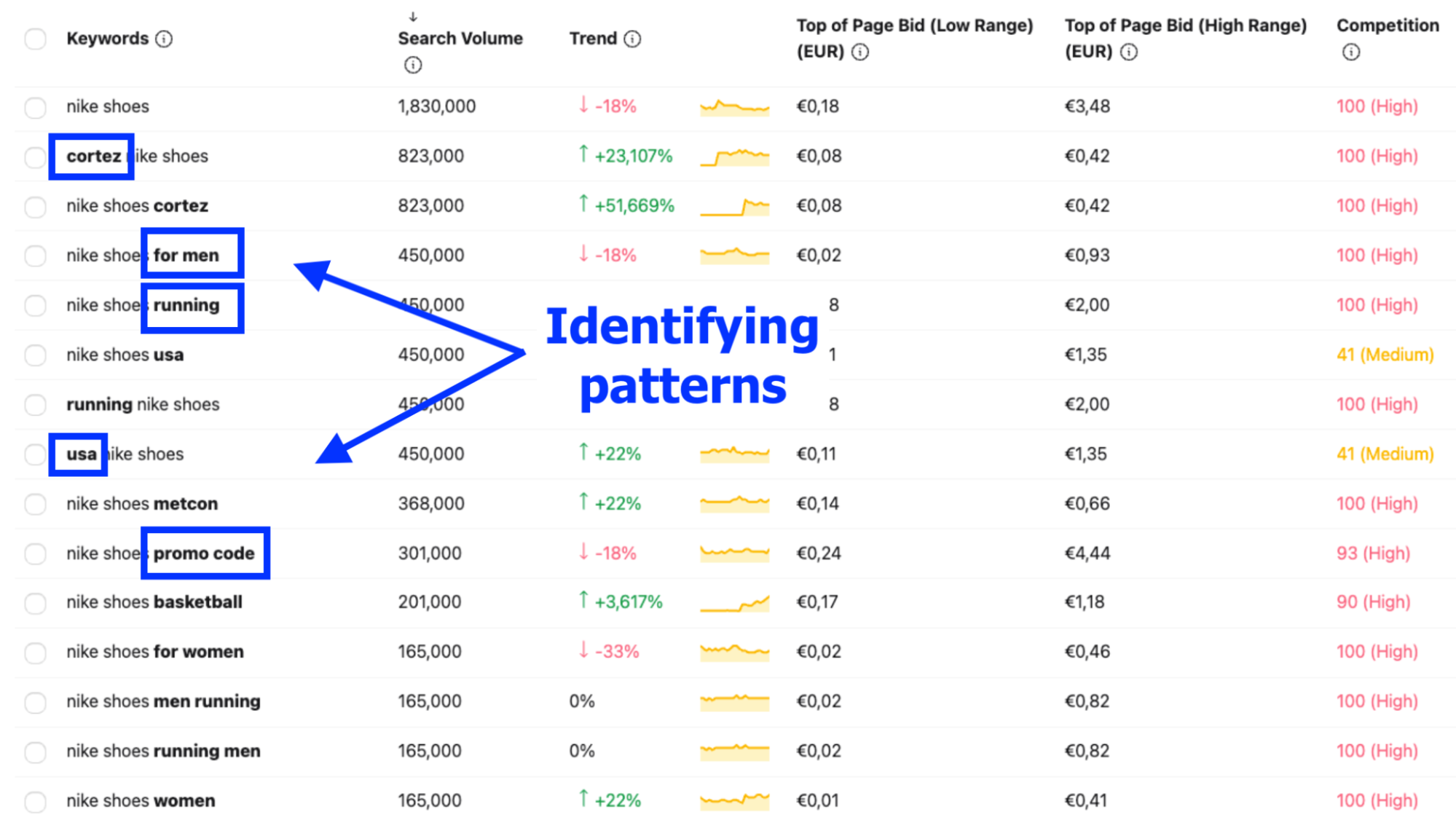
From this list, we can easily identify patterns that can be converted into characteristics that act as a classifier or, at least, an initial draft:
- Searches for shoes + Nike + market (USA)
- Searches for shoes + Nike + model (Cortez, Metcon, Air Force, Jordan)
- Searches for shoes + Nike + user (men, women, kids)
- Searches for shoes + Nike + sport (running, basketball, golf)
- Searches for shoes + Nike + discounts (promo code)
A partial reading of the information could lead us to approaches that are not very scalable or directly to the wrong approaches, so the analysis of the product and available catalog will undoubtedly be the starting point.
Furthermore, at the SEO level, efforts in keyword research, together with user research, will be the optimal way to work together with UX and product to build the best architecture.
Some of the SEO implications we encounter are:
- Each category must have a minimum amount of content.
- Determine whether an item can be in more than one category.
- Plan the categorization of seasonal or commercial content.
- Logical categorization does not necessarily have to coincide with the definition of URLs.
CMS usually determines what can and cannot be done. The more customized the architecture, the more difficult it will be for the CMS to offer it as standard. Weigh up scenarios with their pros and cons; sometimes it is more worthwhile to minimize risks and choose an option that, although not the desired one, is the most balanced in terms of effort-benefit-risk.
Depth
With our organization and navigation systems, we want users to find what they are looking for without having to click too many times, with a special focus on priority business content.
This concept will already benefit search engines, allowing them to crawl and index pages efficiently.
To this end, we have various elements in place to ensure optimal navigation in terms of both UX and SEO.
- Global navigation: via a fixed menu on all pages.
- Local navigation: via specific menus on certain pages, such as footers that can be customized for each page.
- Contextual navigation: via link blocks based on the context or theme of the page.
- Supplementary navigation: through pages solely intended to facilitate understanding of the architecture, such as HTML sitemaps or page indexes. This is common in large stores.
In addition to the four general types of navigation, there are others, such as breadcrumbs, facets, and pagination.
Breadcrumb navigation is important for UX and SEO, replicating the structure of the website, not necessarily that of the URLs. They are a key element of internal linking and provide hierarchical signals, which are key to understanding the architecture.
Establish an internal linking strategy that is 80% fixed and reserve 20% for seasonal layers, launches, and other strategic pages.
Facets and filters
Faceted navigation is a system widely used in listings that utilize characteristics to facilitate filtering.
There are mainly two types:
-
Sorting facets (alphabetical, by price, etc.) that use the same content in a different order; these are not useful for SEO, but they are for UX. In the example, on the right-hand side, we can access the filters or sorting facets.
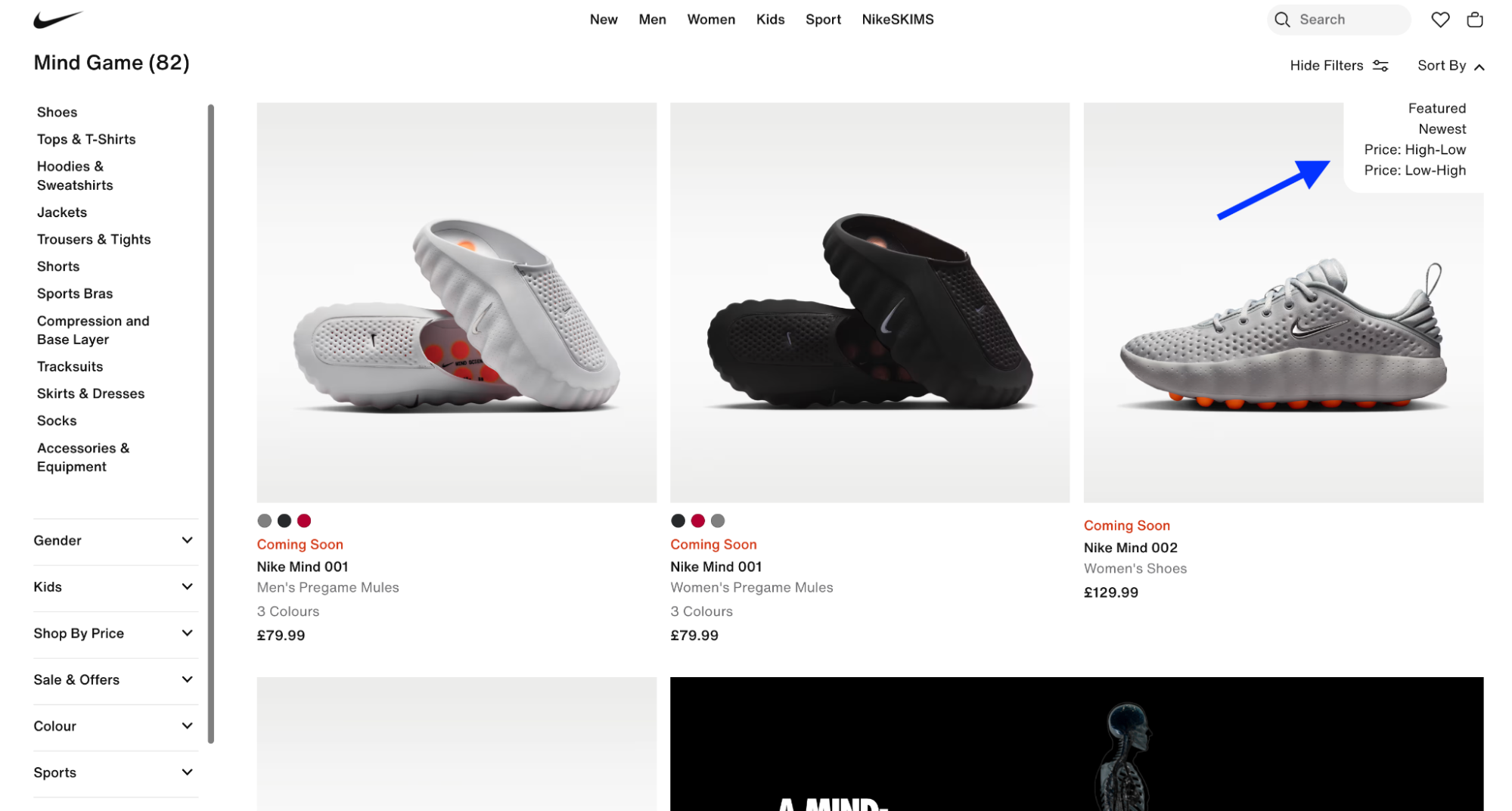
These facets usually influence URLs, adding a parameter or using the same URL as the category they are in, dynamically.
In the Nike example, this is done with parameters:
?sortBy=priceAsc -
Facets that restrict or specify content, so each URL will display different content, which is useful for SEO. In the same example, if I go to the left side, I can apply facets such as Gender, Kids, Color, Sports, Brand, etc.
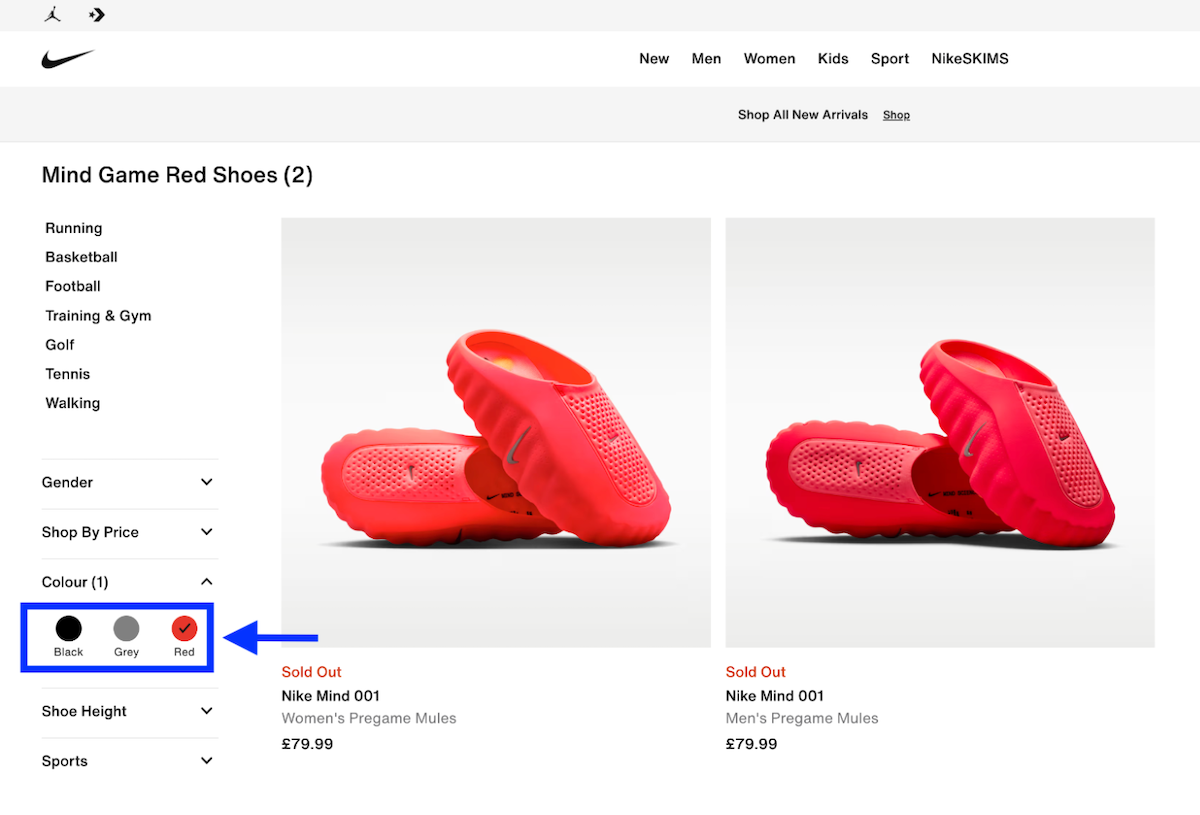
If I select "shoes" and "red", the list of 82 products is now reduced to a list of 2 products that meet both selected criteria.
Nike builds its own URL
/mind-game-red-shoes-3abn9zavwzy7okand does not use parameters for this type of facet.
The key is to identify the level of opportunity we have with filters or facets, also considering the options available in the CMS.
I have encountered everything from CMSs that allow for a high level of customization, where you can decide what to do with each facet, to the complete opposite, CMSs that apply the criteria to all facets, with no customization possible and forcing us to make binary decisions of all or nothing.
The considerations are:
- On-page elements and content: can I have my own title, description, h1 and content, or will the facet inherit the same as the category to which it belongs?
- Crawling and indexing elements: can each facet have its own meta robots or canonical? Can it be blocked individually in robots.txt?
- Navigation elements: can I make useless facets not use href attributes to generate the link or generate them dynamically?
Sorting facets can rarely be used for positioning, so focus on identifying whether there is organic demand for the rest of the facets to compete in general or only in certain isolated facets. For the former, work at the "template" level, and for the latter, see if the CMS allows customization. Put the demand they have into context to decide whether to invest resources in your own developments.
Pagination
Pagination navigation is used as a way to divide a category catalog into lists with a finite number of items.
Depending on how the pagination buttons are designed and how many are present as links, the depth can be shortened more or less efficiently.
There are also occasions when infinite scroll or load more systems are used. These can be useful for adapting to user consumption trends, but the risks to technical SEO and the findability of products that are deeper in the categorization must be borne in mind.
Pagination is always a complex aspect of SEO projects, as there is no universal or standard way to deal with it. However, there are different types of pagination to consider:
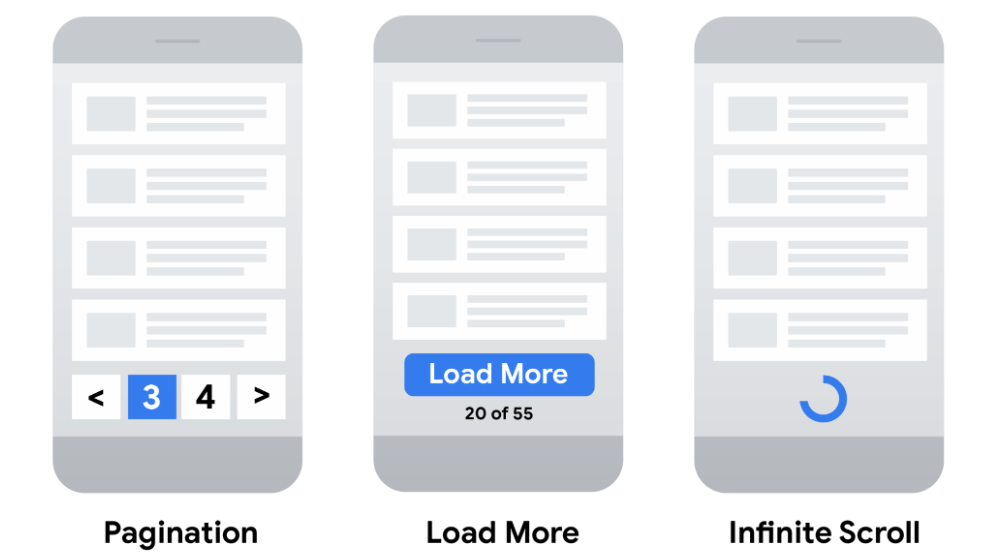
Given that each has its specific advantages and risks in e-commerce, they are summarized in the following table:
| Pagination Type | Key Advantages | Main SEO Risks / Limitations |
| Classic Pagination (numbered links) | Crawlable, unique URLs for each page; facilitates discovery of deep products; strong control over indexation and internal linking; clear SEO authority distribution | Requires more user clicks; may feel less fluid on mobile; needs well-optimized titles and content to avoid duplication |
| "Load More" Button | Improves UX by reducing friction; keeps users longer on listings; can balance modern UX with SEO if properly implemented | Risk of hiding products if JS-dependent; limited crawlability without equivalent paginated URLs; reduced SEO control if architecture is not planned |
| Infinite Scroll | Smooth, continuous browsing experience; highly effective on mobile; lowers interaction barriers | High SEO risk without accessible paginated pages; hinders crawling and indexing of deep products; weaker internal authority distribution; may impact measurement and transactional intent |
Key considerations when choosing how to configure pagination in our e-commerce:
- How many products can we display in each listing without excessively compromising technical performance and loading speed? Keep in mind that the fewer products we display per listing, the more pagination URLs there will be.
- Identify whether all products are equally important, or whether some products are more important than others.
- Know whether the product catalog is closed all year round or whether we have regular stock or availability shortages, or even periodic catalog changes.
- Have we worked on product linking, or do we have the capacity to improve and expand it? If the answer is yes, the impact of pagination will be infinitely smaller.
- Consider rel next rel prev markup. Although Google discontinued it in 2019, it is still in effect for Bing and, indirectly, LLMs are likely to consider it.
- Making pagination crawlable and indexable will always be good practice, with a view to making all products discoverable and findable in deeper paginations, not just the most prominent ones in paginations 1, 2 or 3.
- If you want to cut down on pagination and your products are not searched for directly, in many cases it is preferable to use "previous" and "next", increasing the product grid as much as possible.
When in doubt, start with a simple or basic implementation, making pagination accessible and indexable. After that, you can iterate to more customized implementations.
4. On-page SEO by template
Another fundamental aspect of successful SEO strategies in 2026 is working on our store's templates. It is true that each CMS has its own idiosyncrasies in this regard, but it is worth making an effort to achieve the best possible approach, combining SEO, UX and performance.
Templates are the foundation on which the shop is built, so we can establish how each type of page should look by default, based on criteria of quality, usefulness and conversion orientation.
An interesting resource is SEO Wireframe Design Playbook, which offers different visual proposals by page type and can serve as a manual of best practices. You can view it here.
Let's see what to do for each type.
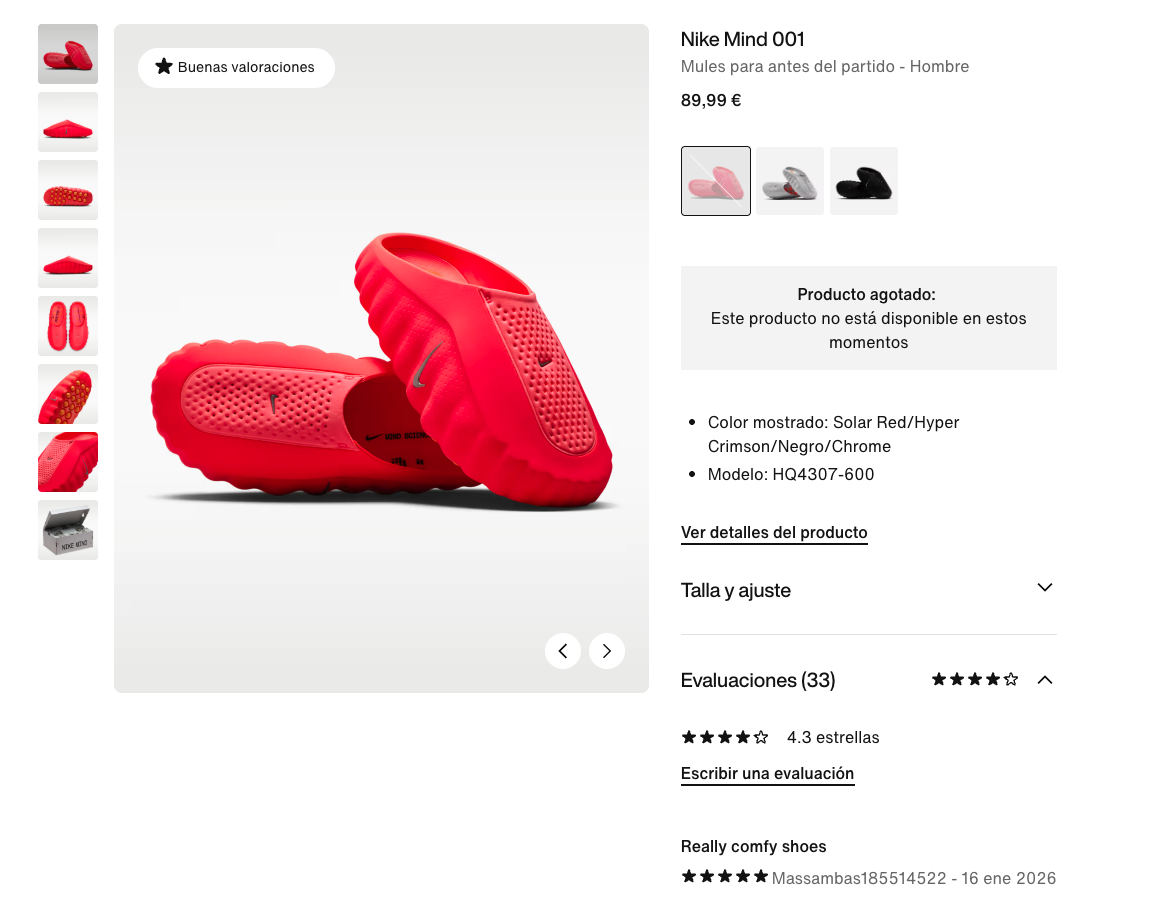
Product pages
The elements we should consider including in the product page template are:
- Invisible elements: such as metadata (title, description) or structured product markup (Schema).
- Headings: headings to indicate the product name and other sections such as description, frequently asked questions, reviews or related products.
- Multimedia: different images of the product or of people using or wearing the product, with the corresponding alt, title and caption markup. Adding videos is also desirable.
- Useful and original content: make the content as useful as possible for users who are potentially interested in buying. Add general and technical details about the product, measurements, technical specifications, as well as the problems it solves or pain points it addresses. The more complete it is, the more situations we will cover. Don't forget to carefully choose the frequently asked questions you add.
- Link blocks: consider adding breadcrumbs, as well as blocks that link to related products, related categories and even recently viewed products.
- Conversion-oriented design: where possible, add trust elements such as logos, featured reviews, etc. When out of stock, depending on the chosen strategy, indicate this clearly, add an email collection field to notify of restocking, or suggest an alternative product.
Category pages
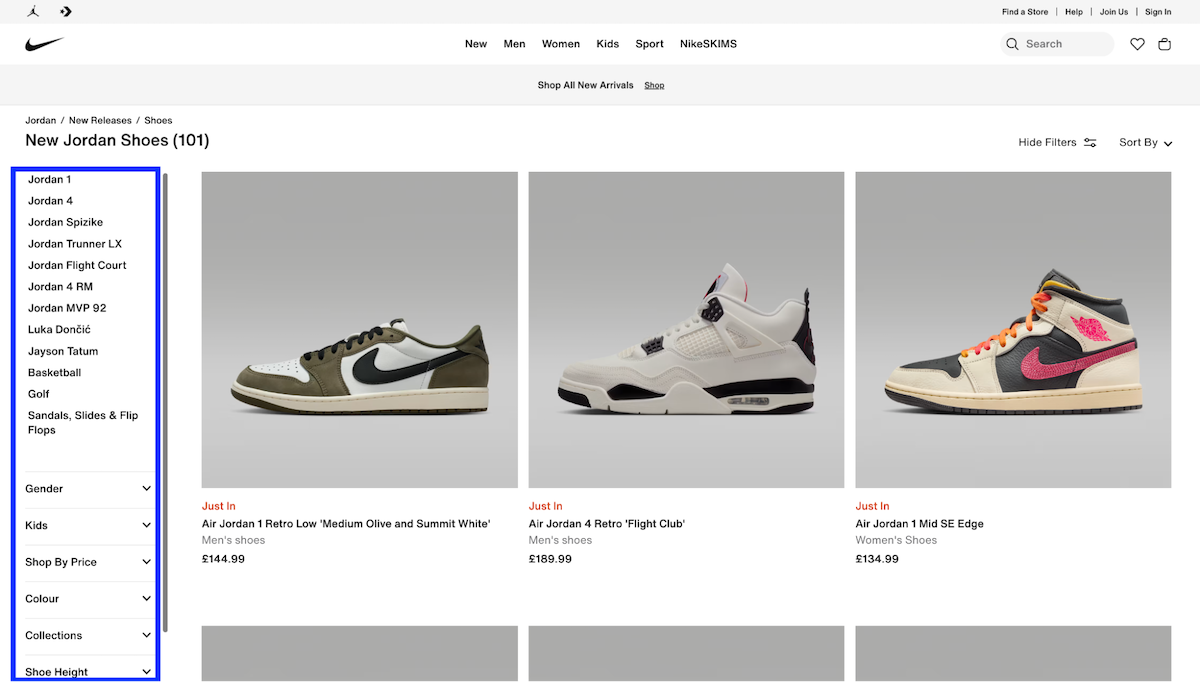
The elements we should consider including in the product listing or category template are:
- Invisible elements: such as metadata (title, description) or structured listing markup (Schema).
- Headings: headings to indicate the name of the category and other sections such as subtitles or related categories.
- Product listing: the order of the products can be strategic to make those that are most interesting in terms of margin, turnover or business strategy more visible. In general, the most important thing is the relevance of the product included in the category, as this will promote a better user experience and help them find what they really need.
- Useful and original content: if descriptive texts are added at the top or bottom, they should be user-oriented, despite the fact that reading trends, as revealed by tools such as Clarity, may lead us to believe that people do not read.
- Link blocks: we can consider adding breadcrumbs, as well as blocks that link to related categories, in addition to adding facets and filters.
- Conversion-oriented design: choose between grid or list formats for both mobile and desktop versions. This is not an SEO decision, but it is important. Consider highlighting certain products to draw attention to them or interspersing blocks with CTAs or text that may be of commercial interest.
Store locator pages
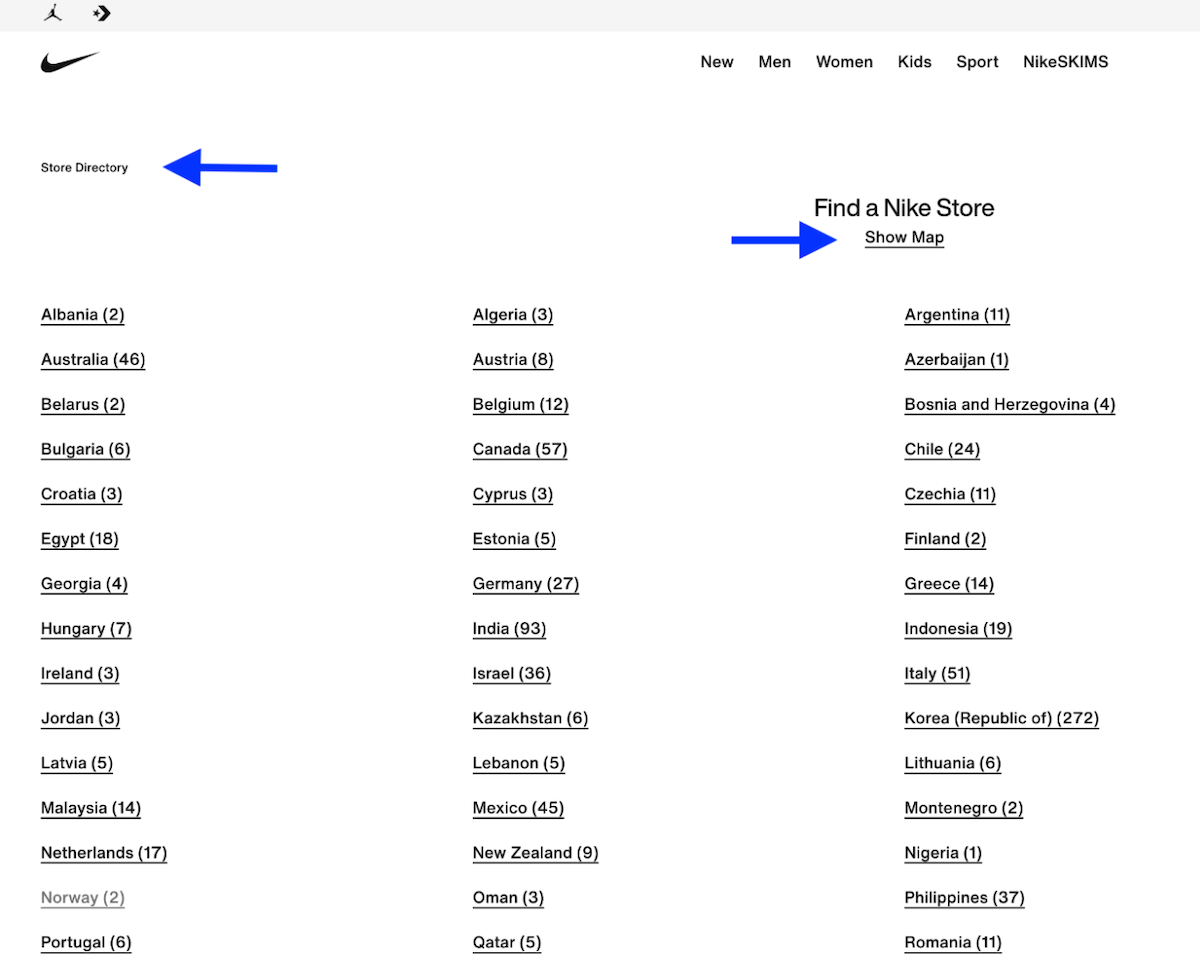
Store locators are our map of shops geared towards UX and SEO. There will usually be direct searches with or without a brand name, for example:
- "Sports shop in ____"
- "Nike shop in ____"
With a well-focused store locator, we can try to capture both types of searches as well as work on local positioning by linking to Google My Business Profile.
We will need to investigate whether searches are concentrated at:
- Country level
- City level
- Neighborhood level
- etc.
Based on the store directory we have and the searches identified, we will be able to establish the right strategy.
Elements that can be added:
- Invisible elements: metadata focused on local searches
- Option to display a map or list of links
- Always link to the higher and lower levels, i.e. if we are in a neighborhood, link to the city; if we are in a city, link to the country and neighborhood, etc.
- Always link to the same level, i.e. if we are in a city, link to other cities; if we are in a neighborhood, link to other neighborhoods. Important: when talking about locations, it is important not to link very disparate cities or neighborhoods just for SEO, but to put UX and CRO into practice, ideally linking nearby locations.
- Make sure the details of each shop are exactly the same as those shown on your property on Google Maps. Being consistent in this will be important for the local layer.
- Add Organization Schema and Local Schema.
Landing pages
For pages that are more commercial or launch-oriented, they do not necessarily have to be transactional in nature, but they are part of a journey that ends in a sale. It is important to try to cover the search intent in the best way possible:
- Invisible elements: not only metadata such as titles or descriptions, but also structured data whenever possible.
- Headings: focus on good hierarchy and maximum clarity.
- Content: each landing page will require a different type of content. The important thing is to try to solve the user's problem, whether with text, calendars, calculators, videos, etc. That is the key: give them what they really need.
- Links: sometimes links are limited to prevent leakage, so think carefully about the role of the landing page and whether it can promote links to other pages or not.
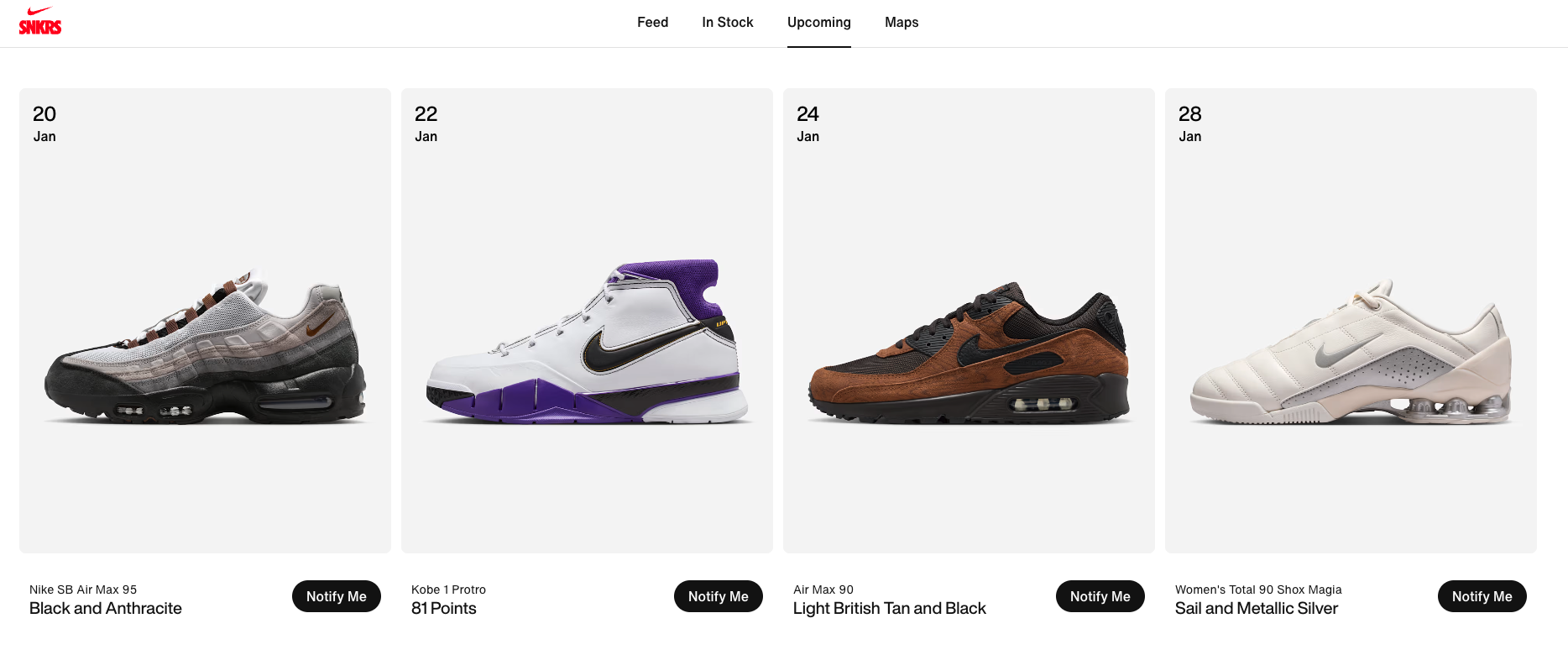
For example, a page with the release calendar for future trainers, which usually generates a lot of interest. You don't need a lot of content or text, just know how to search and give the user what they are really looking for.
5. Technical SEO and User Experience (UX)
Something that any e-commerce business must continue to work on and strengthen is the technical layer and UX.
We do not know what the near future will look like, who will dominate search, or how market share will be distributed in terms of AI and LLMs.
What we do know is that access to content and technical adaptation will continue to be crucial for traditional platforms, as well as for those that have burst onto the scene and those that are yet to come.
Search engines, LLMs, agents... technical SEO will continue to be the gateway!
Let's see what we should focus on.
Crawling and Indexing
The golden rule of technical SEO has always been to allow crawling of those pages that you want to rank or that contain worthwhile internal links.
With regard to indexing, the rule is similar. We index everything that has the potential to rank for a user's search. If there is no search, we do not index.
Although we have already mentioned some exceptions, such as pagination, which are intermediate pages that we cannot exclude from the index in order to support the pages that can be ranked.
How can we work on this?
- Availability: if our site has faults and is unable to be available and accessible most of the time, we will have the first technical problem that we cannot afford with our online shop.
- Robots.txt: the robots.txt file will now not only serve to give instructions to bots such as Googlebot or Bingbot, we will also be able to manage access by bots such as GPTBot, ClaudeBot or CCBot. If you don't let them through, you can say goodbye to part of your visibility in LLMs.
- Whitelisting in Firewalls/WAF: it is more important than ever to check firewalls and make sure that the IPs of all the players we are interested in are not blocked or blacklisted. If you use Cloudflare or similar services, keep in mind that now you have to look not only at Google but also at other agents.
- Sitemaps: The sitemap strategy also becomes relevant in terms of discovery and accessibility of URLs and content. Beyond the requirements of 50,000 URLs per file, it is worth considering the use of multiple segmented sitemaps that also help us track metrics in Google Search Console.
- Meta robots attribute. The directive that determines what is indexed or not also becomes crucial, because if we want to be cited in AI Overviews or other AIs, only what is indexed will be available. AI redefines indexing strategies and project hygiene.
- Rel canonical attribute. Another technical aspect to continue considering is the canonicalization component. Although it is not a mandatory directive by Google, it remains an element that adds signals and consistency to the project. The most important thing is to be coherent and consistent with all signals.
- Nosnippets attributes. As with indexed URLs, those in which we use attributes to hide or not show certain pieces of content in the results pages will also have a direct impact on eligibility to appear in AI responses.
When you start creating your SEO strategy for your e-commerce site, after conducting keyword research, define your indexing strategy by creating a document that shows which pages are indexed and which are not. This will be an explicit way to clarify the overall direction of the project.
Core Web Vitals
The Core Web Vitals are a set of three web performance metrics that Google uses as a ranking factor:
- LCP (Largest Contentful Paint): the time it takes to display the largest and most important element that the user sees when entering the website (usually the main image or a large block of text) within the visible area. In e-commerce, this means: "When do I actually see the store and can start making decisions?" If the LCP is slow, the user feels that the page or category "isn't loading" and the bounce rate increases.
- CLS (Cumulative Layout Shift): a measure of how many unexpected "jumps" the page makes while loading (when visible elements change position). In e-commerce, it means: "Does the page move and cause me to click wrong?" Typical examples: a cookie banner appears and pushes the add to cart button, images load without reserved space and the content jumps. A low CLS prevents those unwanted clicks and frustration.
- INP (Interaction to Next Paint): measures the actual response of the page to interactions (click, tap, keyboard) during the visit. From the moment the user interacts until the website displays the change on the screen. In e-commerce, it means: "When I tap on a size, a filter, or "Add to cart," does it respond instantly or does it take a while?" Poor INP = feeling of a "slow" website, repeated clicks, filters that take a long time, cart that updates late.
Stores are generally supported by CMS such as Magento, Salesforce Commerce Cloud, PrestaShop, Shopify, etc., and most of these CMS load many CSS and JS files that cannot be optimized or removed because they are usually critical functionalities.
For this reason, we are often unable to carry out in-depth optimizations, which is one of the technological debts we suffer in the field of SEO, especially when we are working on projects of a certain size.
Where we can focus more specifically is on images, which account for a large part of a page's load (especially in categories and products with many images). To do this, we can focus on:
- Categories: It is critical that images are well compressed and use a deferred loading system such as lazy loading so that instead of loading all the images in the list at once, they are loaded progressively as the user scrolls.
- Products: in product listings, it may be a good idea to find a good balance between compression and image quality. Keep in mind that in e-commerce, image and quality can be decisive factors in the purchase decision (a highly compressed but pixelated image can lead to a rejection of the purchase). The middle ground is usually the best option.
- Another detail to keep in mind is to load images with sizes adapted to mobile devices. We cannot make mistakes such as loading a 2400px image that must be processed and then adapted to mobile devices.
- Avoid excessive use of pixels and be careful not to inject scripts that are not being used.
- In projects where we have greater control over development, we can consider reducing CSS files and scripts or even decreasing unused code. In projects with more technical dependencies and larger sizes, it is more difficult to have a significant impact on these types of aspects.
How can we diagnose Core Web Vitals? Before looking at the possible tools, it is worth mentioning field data and lab data.
Regarding field data:
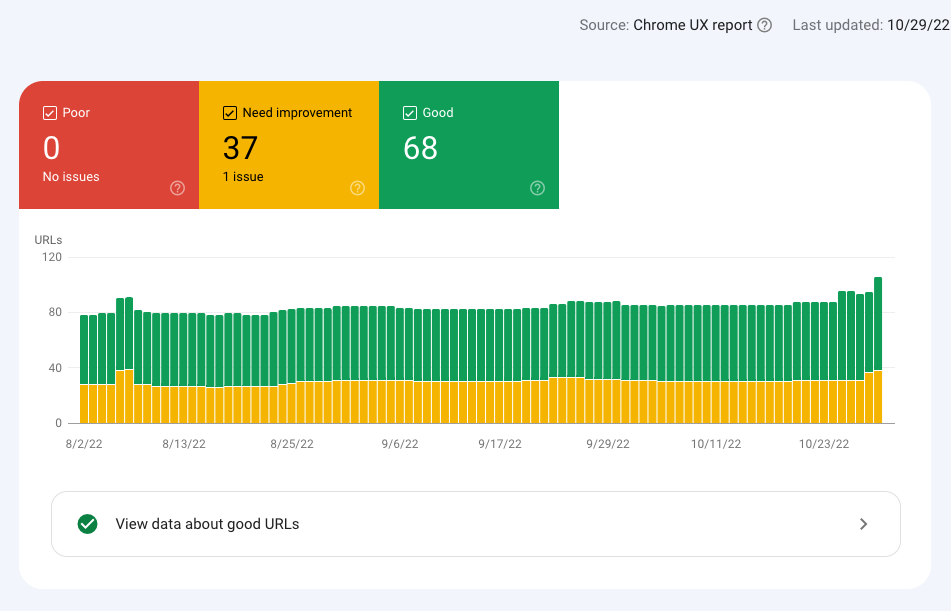
- It comes from real users (Chrome UX Report – CrUX).
- It is based on a 28-day moving average.
- This is what Google actually uses to evaluate your site.
You can find this data in Page Speed Insights and Google Search Console. Its biggest drawback? Changes are not reflected immediately.
Regarding lab data:
- It is generated by tools under controlled conditions.
- It is used for diagnosis and testing.
- It does not necessarily represent actual usage.
You can find this data in PageSpeed Insights, Lighthouse, and Chrome DevTools.
What tools are available and how can you use them?
-
Google Search Console: Ideal for a comprehensive overview based on field data.
-
PageSpeed Insights: Combines field and lab data at the URL level. A good idea in e-commerce is to analyze one URL of each type, for example, a product page, a listing or category, a campaign page, or a store locator page.
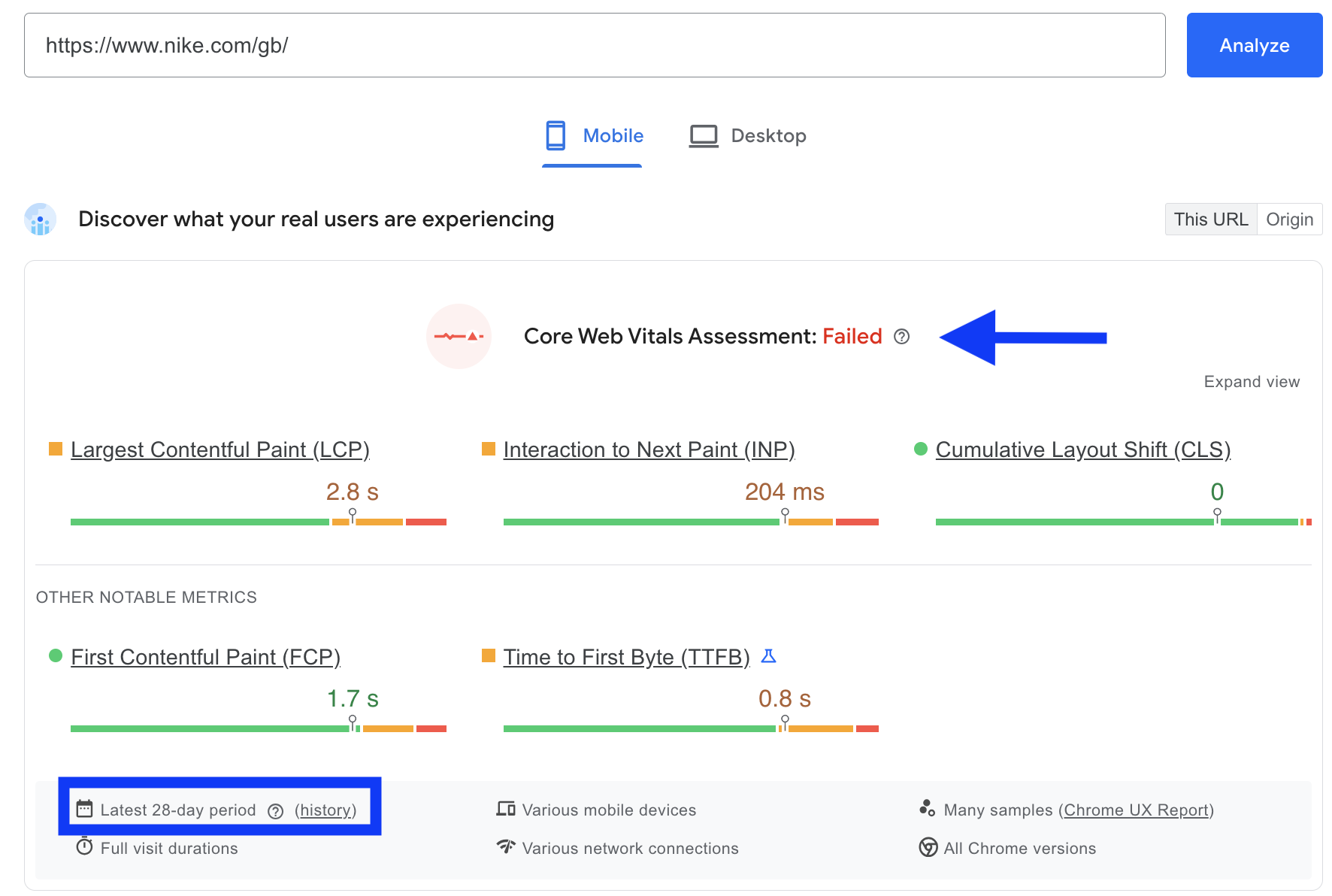
If CrUX data is available for your website, you can access the History and see how all the metrics have evolved. Therefore, if you click there, you will open the CRUX Report on CrUX Vis.
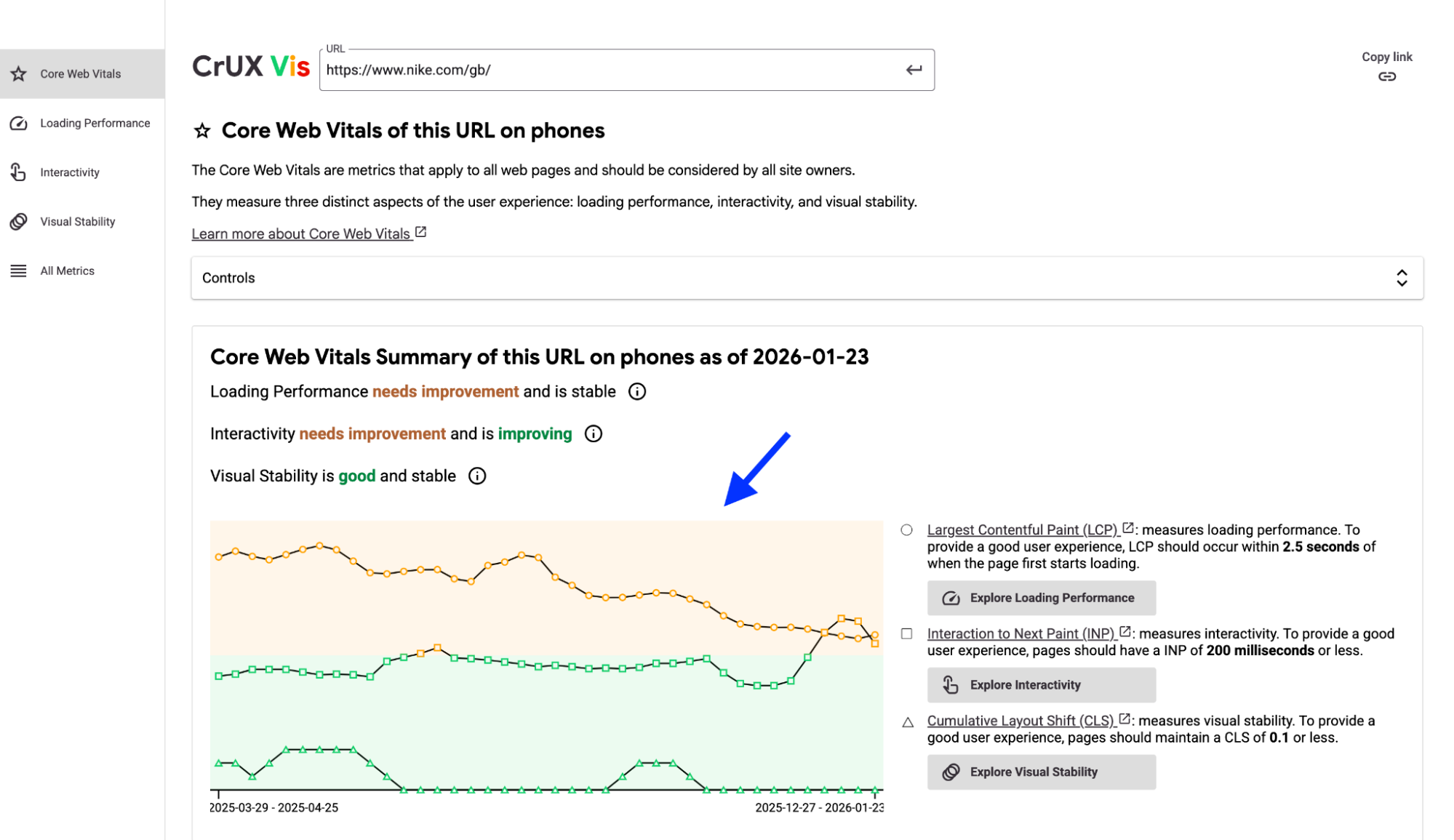
In Page Speed Insights, you will also find specific performance information and, further down, recommendations for resolving any issues.
-
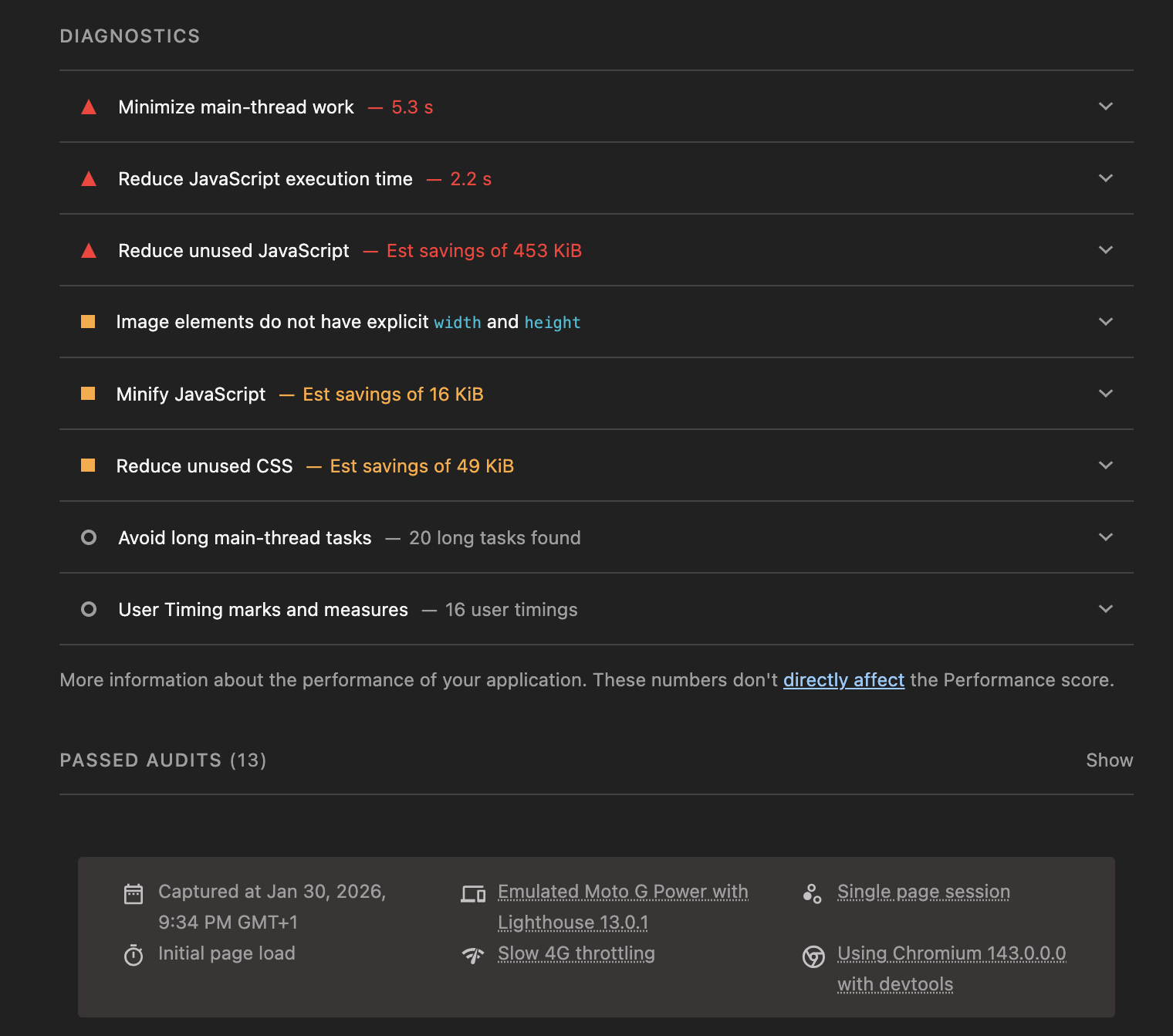
Lighthouse: Very useful for quick tests in a local environment, interesting for defining reproducible scenarios (same throttling, same device) and being able to run tests before and after making improvements.
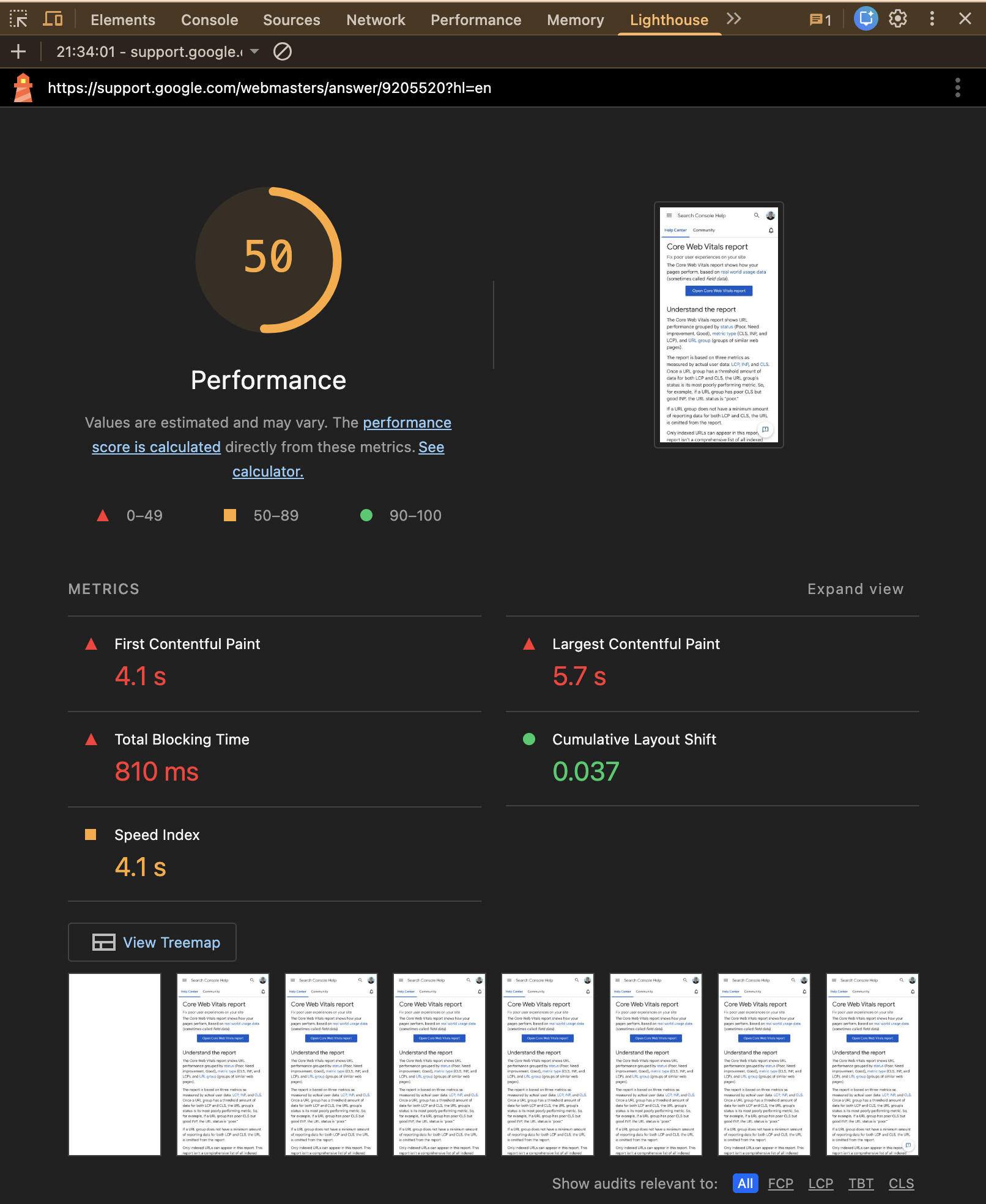
If you plan to make improvements to categories or product pages at the template level, this is a great way to test them.
In addition, you will be able to access more specific insights and diagnostics so that you can continue to improve, as well as indicate everything that is correct in approved audits and obtain a summary of the emulation conditions.
-
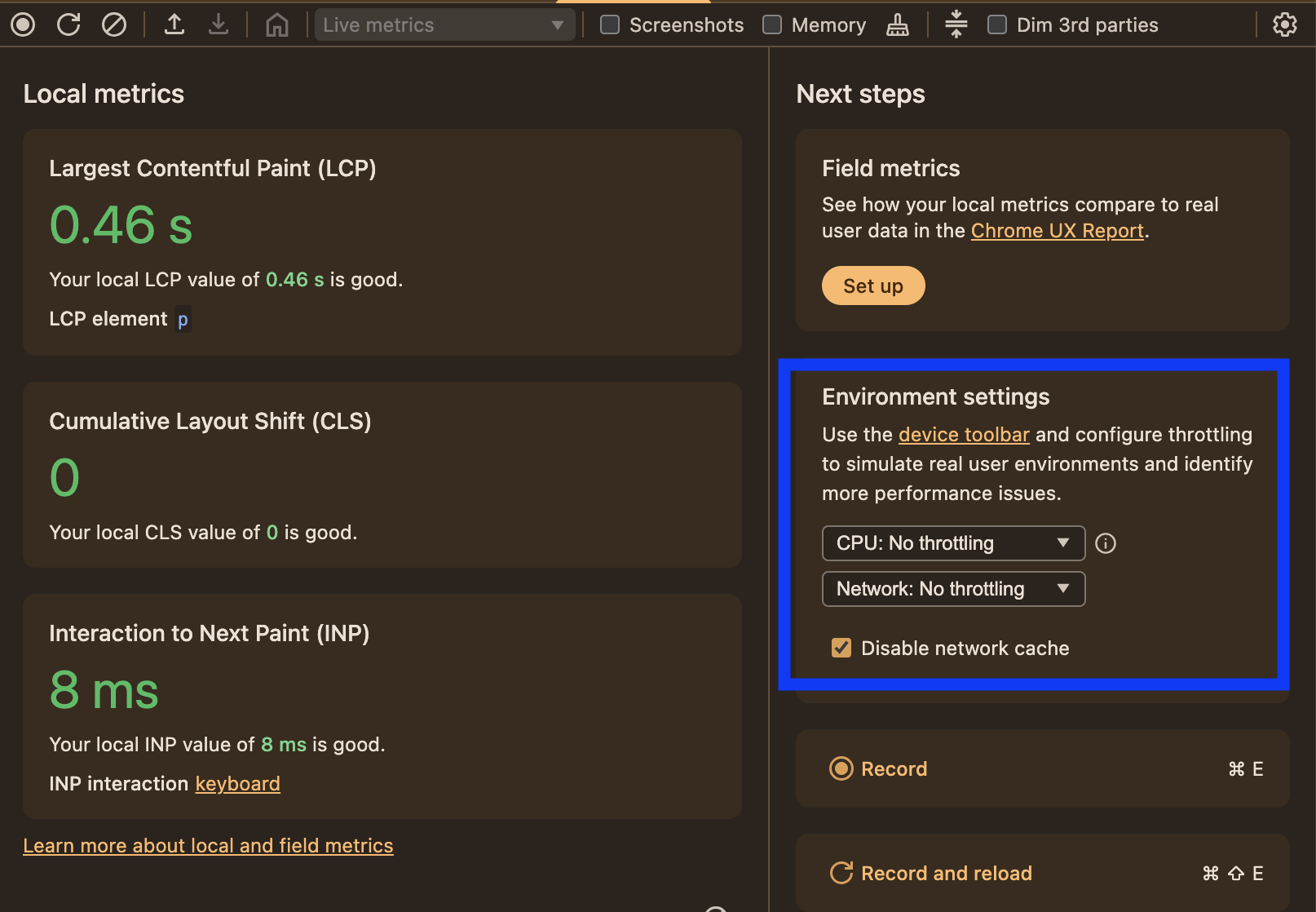
Chrome DevTools (Performance tab): Perfect for analyzing LCP and rendering on sites under development, but it won't give you scores or ratings. This feature does not generate scores or automatic recommendations, but rather allows you to record what actually happens while you load or interact with the page for observation purposes and to identify the "whys" of possible problems.
-
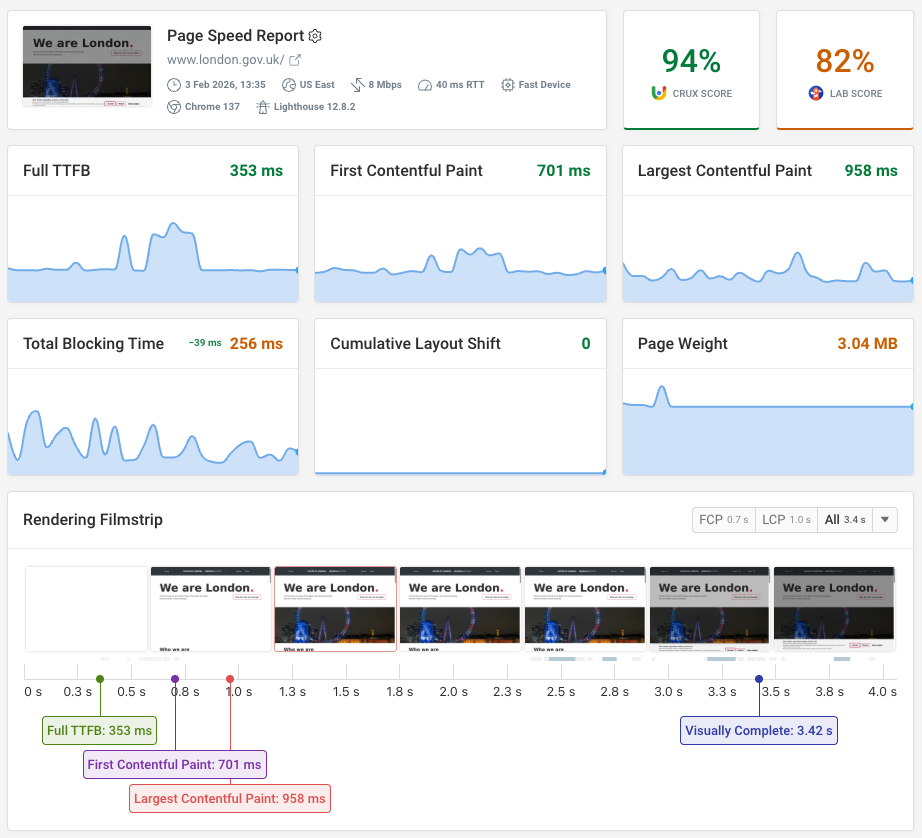
DebugBear: Especially useful for continuously monitoring Core Web Vitals, analyzing field and lab data, and detecting performance trends over time, both at the page level and across your e-commerce templates.
The request waterfall visualization provides detailed technical insights on what resources are loading on your website, how long they take to load, and how they impact what users can see.
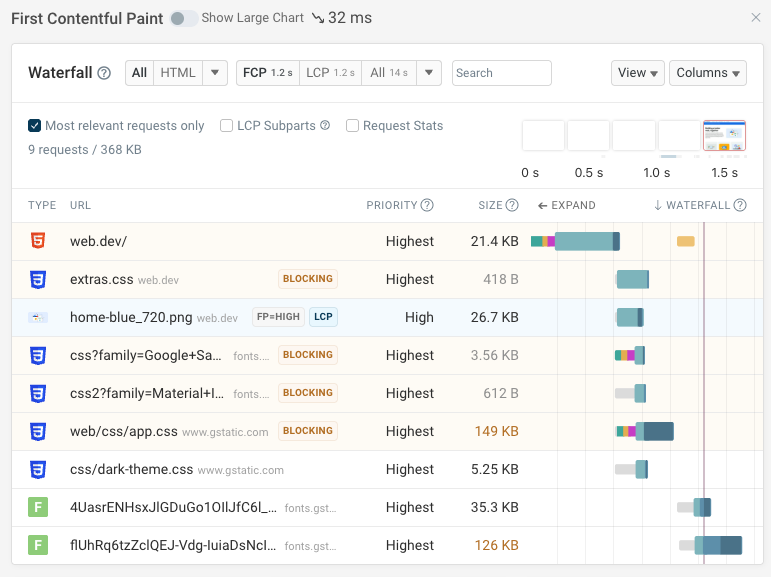
Perfection here does not guarantee better performance. Achieve the best standards you can, reviewing the average for your sector/competitors, and commit to continuous monitoring.
Mobile-First
The concept of mobile-first indexing means that Google will focus primarily on the mobile version of e-commerce, both for crawling and indexing and subsequent ranking.
This means that it is very important to monitor the mobile version at all levels:
- Ensure that there are no gaps in content.
- Work on internal linking.
- Have the best possible architecture.
- Etc.
Therefore, no matter how good the desktop version is, don't lose sight of the fact that Google's eyes will always be on the mobile version.
At a strategic level, this concept is closely related to user experience and also to performance concepts such as Core Web Vitals and conversion layers. Our priority must be to take the utmost care of all the layers mentioned in the mobile version.
Follow Google's recommendations and ensure that no important content or elements are missing from your mobile version.
Be very careful when serving different versions of content, links, or structured data on desktop and mobile devices, as this could cause many problems.
Javascript
On a technical and strategic level, a key aspect is the use of JavaScript within the project. This can occur in several ways:
- The e-commerce is based on or built on a JavaScript framework such as React, Angular, or Vue.
- The e-commerce site is built with a more traditional CMS, such as Magento, Prestashop, Shopify, or Salesforce Commerce Cloud, but has specific JavaScript-based features (link blocks, menus, filters, etc.).
Therefore, it is important to be aware of the degree of dependency of priority pages or relevant content on JavaScript, because this will determine our degree of risk of not ranking correctly if we do not have the appropriate technical configuration. What are the options for "doing it right"?
- CSR: client-side rendering renders content on the client side, i.e., in the browser. This is the worst option from an SEO perspective.
- SSR: server-side rendering renders content on the server side.
- Prerendering: prerendering generates static HTML versions of pages before the user accesses them, allowing search engines and other systems to consume the content without having to execute JavaScript in real time.
- Hydration: through hydration, the client's JavaScript "activates" already rendered HTML, adding interactivity to a page that was initially served as static content or rendered on the server.
| Technique | Where content is rendered | SEO friendliness | Perceived performance | Technical complexity | Recommended use in ecommerce |
| CSR | In the user's browser | Low / problematic | Slow initial load | Medium | Avoid for SEO-critical content (products, categories, indexable pages) |
| SSR | On the server, before delivery | High | Good | High | Ideal for complex ecommerce sites with dynamic content and SEO needs |
| Prerendering | Pre-generated HTML (build or cache) | Very high | Very fast | Medium | Highly recommended for product pages, landing pages and stable content |
| Hydration | JS runs on the client over pre-rendered HTML | Neutral / dependent | Variable | Medium | Add interactivity without compromising indexability |
If we review how Google works with JavaScript, what it does is process pages in three phases: crawling → rendering → indexing.
In the initial crawl, Google downloads the HTML and evaluates robots.txt, metadata, and links. Then, if it deems it necessary, the page is sent to a rendering queue where a headless browser (Chrome) executes the JavaScript to generate the complete HTML that will ultimately be indexed.
These points are very important for our e-commerce SEO project:
- Whenever possible, render content in the initial HTML (SSR, prerendering). This prevents important elements from being relegated to the rendering phase, where Google may take a long time to process them or may not even process them at all.
- Must have: avoid blocking JavaScript and CSS resources in robots.txt. This is a critical point because if they are blocked, Google cannot fully render or index the page.
This clarifies the available options and Google's general approach to JavaScript, but again, we cannot focus solely on Google; we must also consider LLMs and AI-assisted search systems such as Gemini, ChatGPT, Perplexity, and Claude.
These systems are not always able to process JavaScript in the same way as Google or a modern browser, so, whenever possible, priority should be given to making e-commerce accessible from the initial HTML using SSR, prerendering, and controlled hydration.
Finally, from a purely strategic point of view, considering the use of JavaScript only where necessary to ensure a solid, accessible semantic base is not a trivial decision, as this will directly affect not only SEO, but also the user experience and current and future visibility in traditional and AI-based search ecosystems.
Less is more. Try to make technology stack decisions that are as balanced as possible for the product, business, and SEO. The use of JavaScript can have advantages in terms of interaction and visual results, but the costs and technological debts, as well as the impacts on rendering and accessibility of search engines and LLMs, must be considered.
Structured Data (Schema Markup)
Another must-have in an e-commerce project is the implementation of structured data through Schema markup. This reduces the ambiguity with which search engines and AI-based systems interpret the content of a website.
Although this markup does not provide a direct ranking improvement, it does facilitate greater and better semantic understanding, as well as reinforcing consistency in the use of entities, products, brands, etc.
Let's say that this markup currently provides an explicit context that is necessary in times when the organic ecosystem is expanding to different platforms with and without AI.
Depending on the type of page on our e-commerce site, we can generally take the following approach:
- Home: it is particularly advisable to use Organization or WebSite, combined with SearchAction (for internal searches) and sameAs, which allows the brand to be linked to official profiles (social networks, marketplaces, Wikipedia, Google Business Profile).
- Product listings: The recommended one is Product (with key features such as Offer, AggregateRating, and Review).
- Categories or listings: the focus should be on ItemList and the correct relationship with Product entities.
- Editorial content or guides: Articles or blog posts help contextualize content, in addition to specific characteristics such as date, author, etc.
- Author-specific pages. You may consider using ProfilePage to provide greater clarity.
- Corporate or brand pages: Organization, Brand, and perhaps BreadcrumbList are key.
- FAQ content: Using FAQPage allows you to structure frequently asked questions and answers, improve semantic understanding, and facilitate reuse in both rich results and LLM-based systems, provided that the content is visible and relevant to the user, whether in categories, products, or specific FAQ pages.
- Store Locator: it is essential to use LocalBusiness (or subtypes such as Store), along with properties such as address, hours, geolocation, and sameAs, connecting each point of sale with its local profiles.
Since each project is unique, the best advice at this point is, before implementing anything, analyze and reflect on what information is likely to be marked up, what entities we can include per page, what the internal and external mentions are, and above all, how quickly those mentions are growing, in order to have an implementation plan but also a maintenance plan to be able to update the markups and always be prepared and semantically focused.
Tips for avoiding problems
- Align teams and create an SEO culture. Establish a common framework and avoid isolated decisions that could negatively impact the project.
- Think more about rules and systems than isolated actions. Instead of treating pages as individual and manually implemented, try to create a system for each type of implementation so that it is always done the same way. For example: establish a minimum number of items to be displayed in a category; if this is not met, the category cannot be created. This allows us to anticipate architectural problems that often trigger the indexing of many pages with little content, duplication, and minimal value.
- Document the "why" behind technical decisions. Having a history of why certain decisions were made allows you to assess risks before making changes and avoids repeating past mistakes.
- Validate before deploying important or risky changes. Prevention requires well-defined testing environments and clear validation criteria. The idea is to be able to test changes on a small scale and confirm that the results are as expected before deploying them globally.
- Embrace simplicity and consistency. If complexity increases in e-commerce, the probability of failure increases. Opting for simple, consistent, and maintainable solutions—even if they are not the most "modern"—facilitates scalability, reduces technical debt, and minimizes long-term problems.
6. Content, Authority, and EEAT
In the age of AI, many e-commerce businesses are asking themselves the now familiar question: can I automate content generation in my store?
There is no easy, single answer to this question. The key factors are who you are and what type of content you need to create; these will be the deciding factors.
Despite living in an era where it is easy to generate content and there are many systems available to do so, in 2026 quality, originality, and authenticity will continue to be important, so we need to understand what can be done about this and focus on how we do it.
This probably resonates much more if we mix it with E-E-A-T issues. If your sector is within the so-called YMYL, you will have to give much more of yourself, but in any case, experience and expertise continue to guide user confidence, so be careful with the content you automate.
Unique descriptions vs. manufacturer copies
One of the biggest challenges of the last decade has always been to offer value when product descriptions come from the manufacturer and ways must be found to integrate them into product flows and web channels.
Content that consists of unequivocal facts or numerical data related to a product is undoubtedly potentially automatable. Detail tables, technical specifications, etc. are perfect candidates for saving time.
However, anything that involves experience, knowledge, and addressing users' pain points should be supported by a real face, an expert who can put their profile at the service of e-commerce.
The best thing any e-commerce business can do right now is to have experts on their teams who can master their subject area not only in their day-to-day work, but also as the visible face on the web and in audiovisual content. That would be the way to close the circle: valuable content, authority, experience, customer focus...
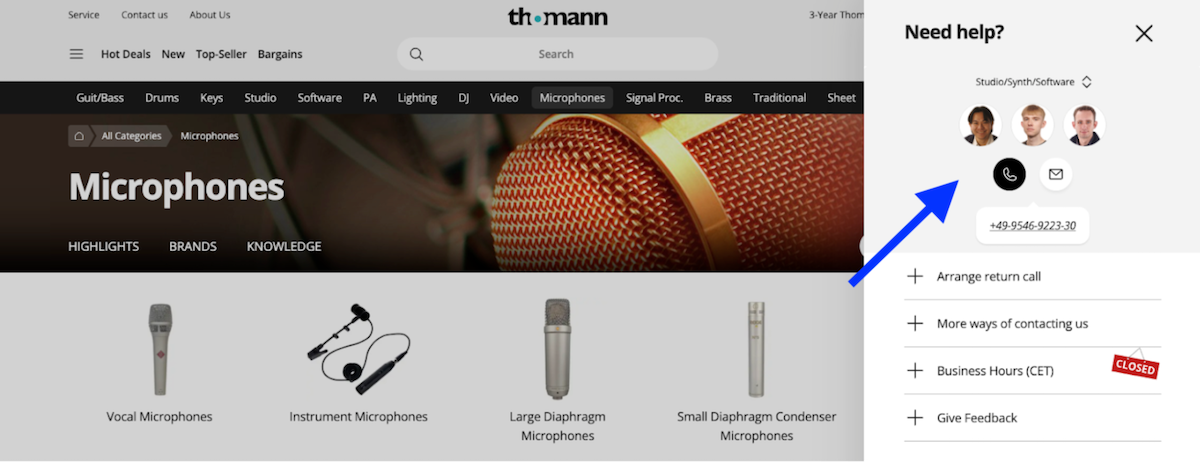
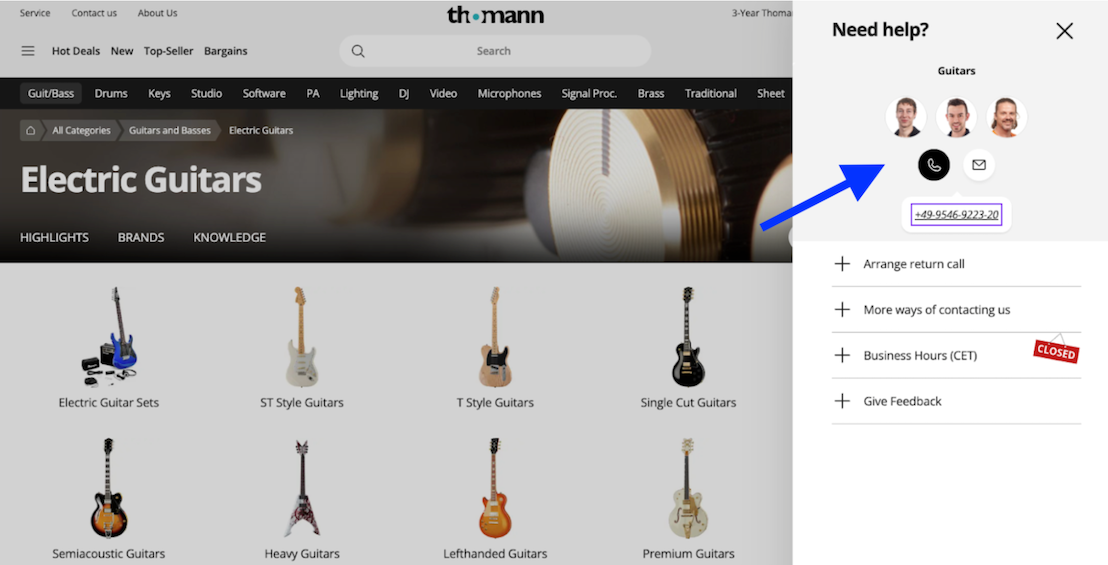
A discreet example of this is the Thomman musical instrument store, which shows the team in charge of each subject area, even if only at the support level, but makes it clear that it has different specialized experts.
Content Hubs and Buying Guides
A type of content that is more informative or commercial, prior to the transaction taking place and which can influence the purchase decision, is buying guides and other content hubs close to conversion.
For example, following the examples in sports, such as how to choose running shoes or how to choose the right size bicycle, we can extract several valuable tips from brands that are already working on this:
-
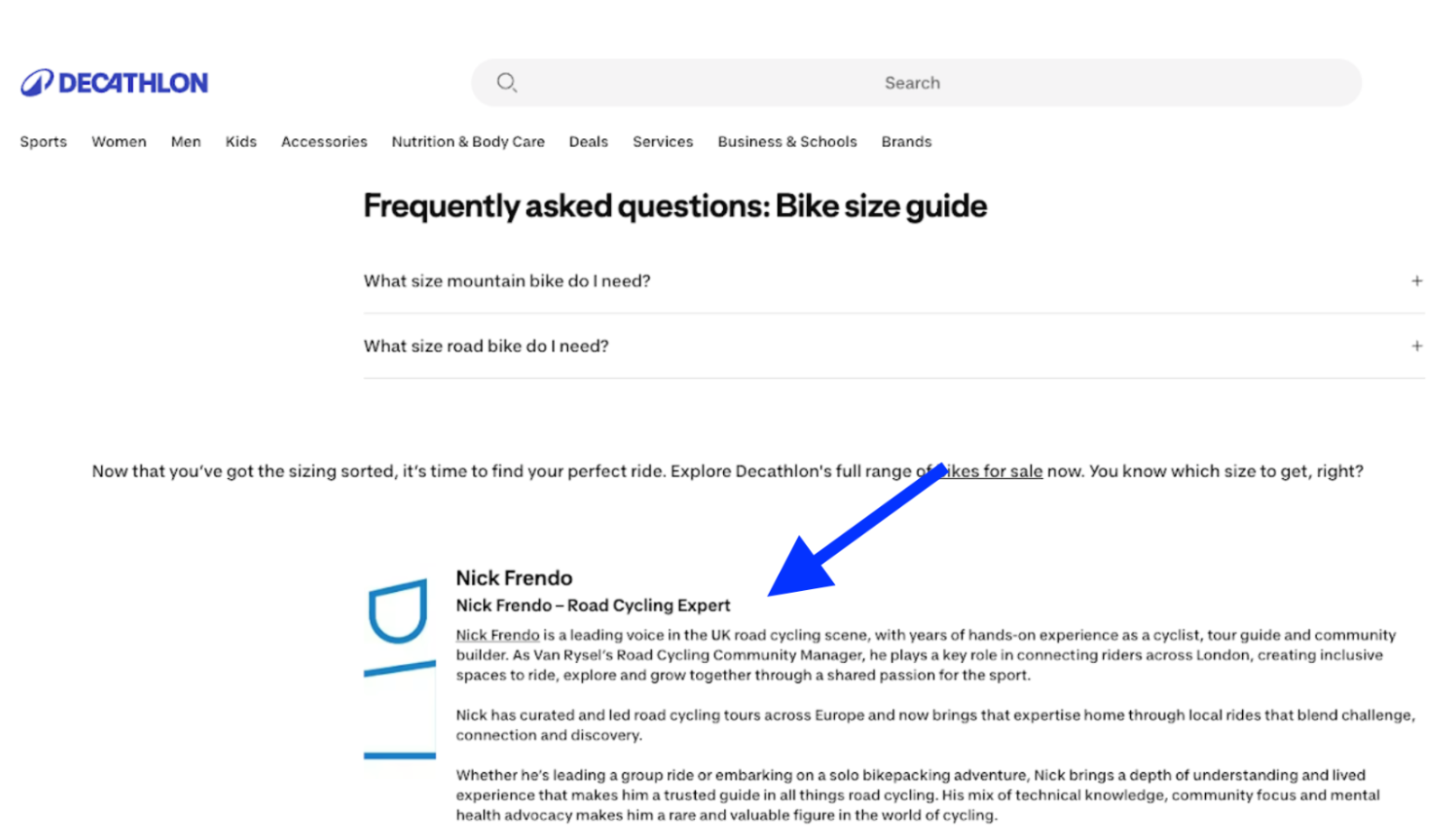
Experts who sign the buying guide support EEAT signals, and if they are recognized in the sector, they will play a key role in conversion.
-
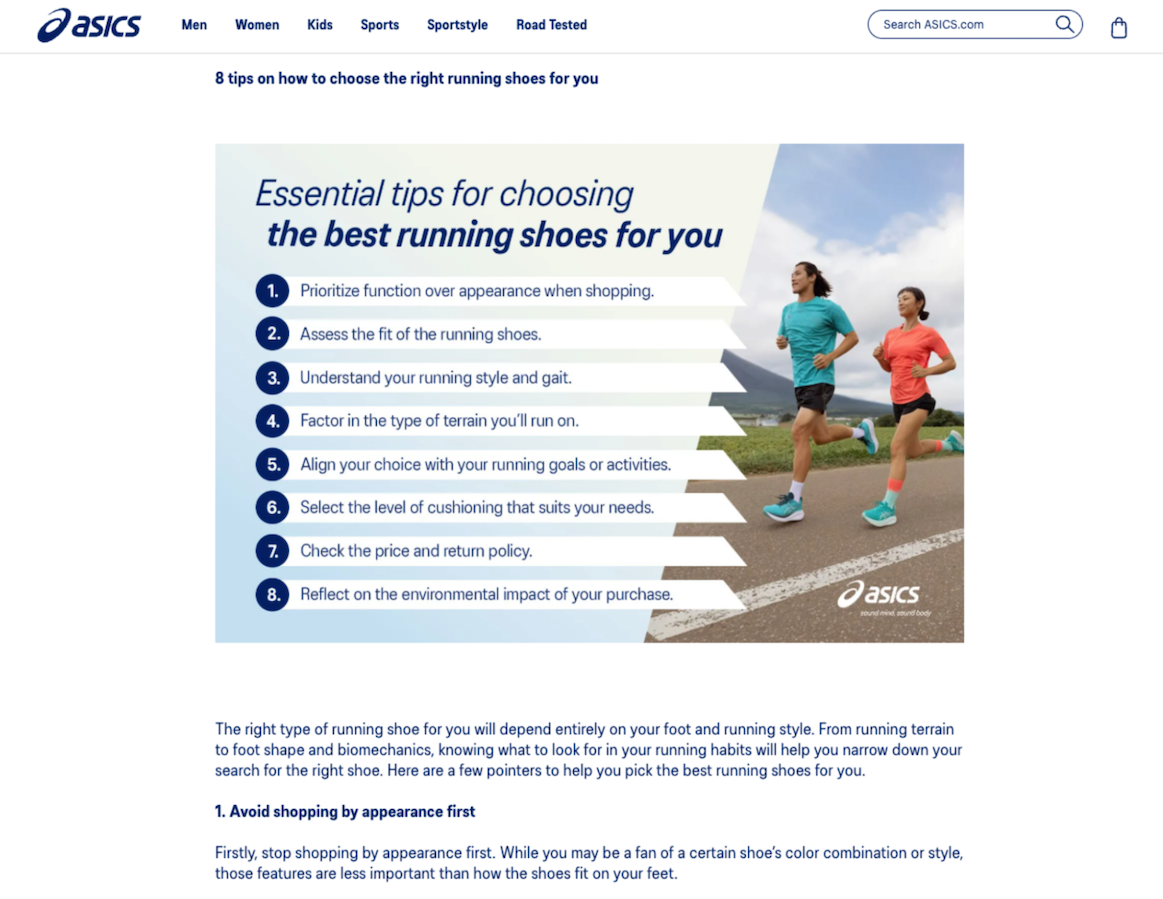
Add not only all the possible questions a user might ask themselves before buying, but also all the objections at the product or product use level, all the types and contexts in which the product can be used—the more complete, the better. In addition, use attractive, visual formats that grab attention and are easy to consume.
Link Building / PR in 2026
In 2026, it will continue to be important to work on obtaining links through public relations strategies and the generation of valuable content. Let's look at some ideas:
- Collaborations with influencers and bloggers
- Sending specialized and trending content to general and local media
- Generating "linkable" content through studies, infographics, ebooks, and expert opinions
- User-generated content through forums or by creating your own community.
In addition, both traditional links and mentions in different content and platforms (prominence) are useful, as these are used by AIs themselves and responses are influenced by the general consensus of the sector regarding our expertise and our appearance alongside other market players (co-occurrence).
Large budgets will continue to have an advantage, and agile and creative teams will have great opportunities to stand out in responses and results.
Local SEO
When e-commerce also has a physical presence, we can add an additional layer to the Store Locator page strategy: GBP. Therefore, not only will we have a series of pages created on the website, with provinces, cities, or even neighborhoods, to create our store directory, but we must also focus on content and linking to map presence.
Each listing must have the correct name, address, and phone number, with differentiated content in terms of services, products, or added value for each store, as well as opening hours and a well-focused on-page approach.
To ensure NAP consistency, it is highly recommended to link from each page to the Google Business Profile map and listing to connect the website and the local entity.
Regarding the GBP listing:
- correct selection of main and secondary categories
- detailed definition of products/services
- use of high-quality photographs that represent the actual premises
- try to capture positive reviews in a timely manner
- link to the URL of the website's store locator, using a "utm" parameter to track traffic
- work on mentions and external links
Local marking with Schema, as we mentioned earlier, is also key to being consistent and coherent:
- Consistency of data and web links + GBP listing
- Well-structured content with local signals
- Obtaining reviews, mentions, and links
Monitor the sentiment of reviews and you will be able to identify insights to improve your product or service. When it comes to getting reviews, try to integrate this into your pre- and post-sales flows, without creating friction or forcing the user.
E-E-A-T and first-hand "Experience"
This concept, which we have already discussed, applies to any website, with greater emphasis on those that influence the health, safety, or finances of users, as these are more sensitive topics and will be subject to special filters by Google.
If we think about it, it's a matter of common sense. Any website must be and appear to be reliable, have experience and knowledge, know what it's talking about, have in-depth knowledge of the product, the sector... A priori, that's normal, isn't it?
What factors can we influence to not only be reliable, but also appear to be so?
- Web design: there are a number of trust elements that, if available, are always worth adding. For example, reviews, quality or trust seals (secure purchase, money-back guarantee, etc.).
- Us, our brand, and our reputation: all "about us" or "contact" pages should be well-crafted and consistent, telling our story with an emphasis on our achievements and the areas we specialize in.
- Experts: our experts should be our authors, with a digital footprint (profiles with their name and activity or third-party references) and biographies or resumes, especially if they are going to generate content.
- Content: unique, quality content, with our own approach and originality, as far as possible.
User-generated content (UGC)
UGC stands for User Generated Content and refers to content generated by users outside of e-commerce. It has become an asset that can be key to an e-commerce project as it provides trust and authenticity.
Reviews, ratings, photos, videos, or comments are able to reflect real customer experiences and act as social proof signals, reducing friction in the purchase decision. Therefore, finding ways to exploit UGC will strengthen the overall credibility of e-commerce.
From an SEO perspective, UGC primarily provides a component of naturalness and freshness that is scalable and aligned with the real language of users. In this way, its integration into stores can enrich product pages with long-tail terms, semantic variations, and additional context that search engines and LLMs value positively. It undoubtedly strengthens the user experience, connecting SEO, CRO, and the brand within the e-commerce ecosystem.
Video Commerce
With the expansion of the organic ecosystem today, opportunities with the video format have skyrocketed, constituting a strategic asset for SEO projects in e-commerce and the ability to reach many more audiences (Gen Z and beyond).
Platforms such as YouTube, TikTok, and Instagram play a key role in the customer journey, particularly in the discovery phase, and act as platforms with their own rules, which multiplies the opportunities to gain visibility: videos can be positioned on each platform, and the URLs of each platform can also be positioned on Google.
Additionally, video platforms such as YouTube are one of the most cited sources by LLMs such as ChatGPT, according to studies conducted by Semrush, which coincide with other tools or companies in the sector.
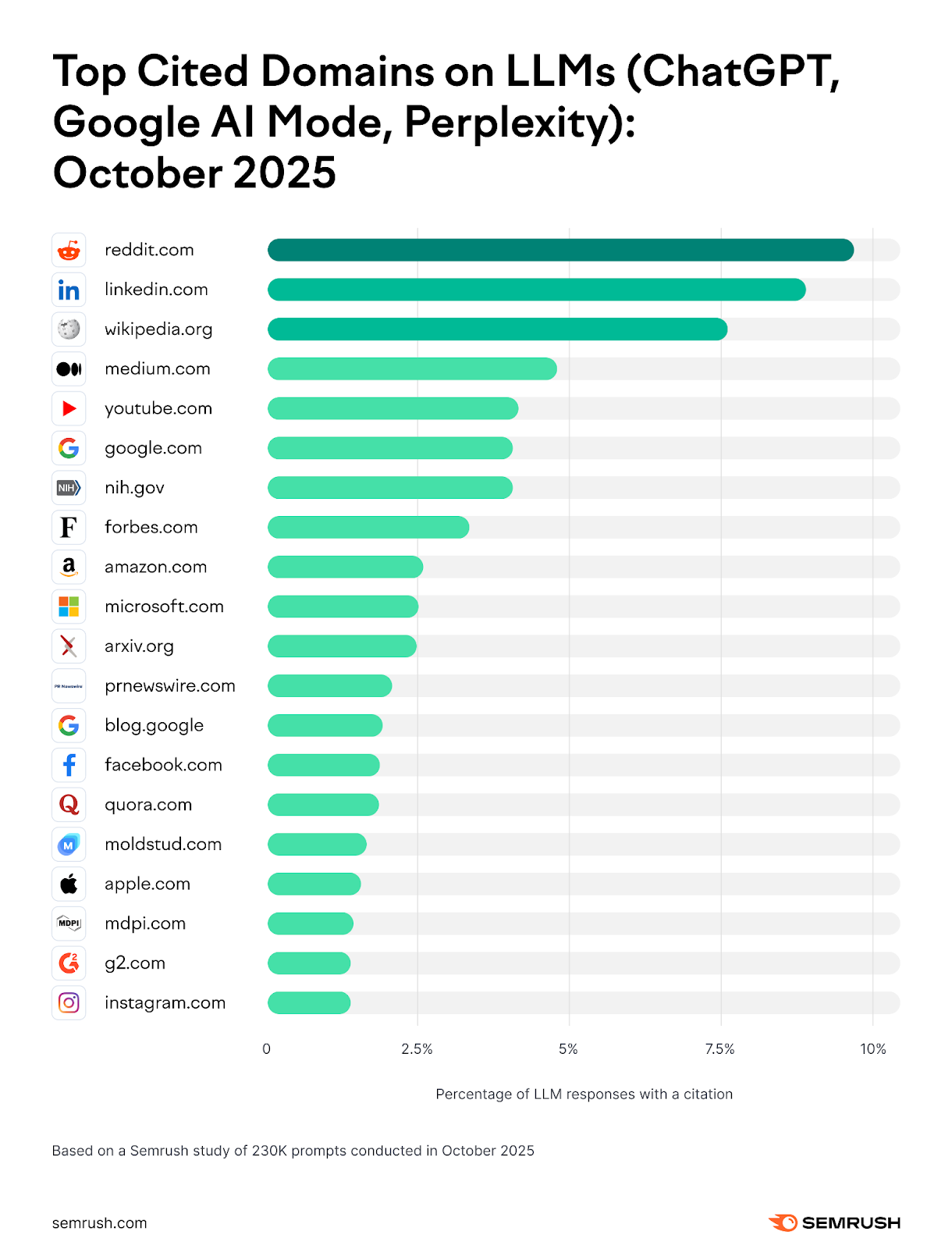
The key strategy here is to incorporate into our e-commerce's overall content strategy which content will be exclusive to video platforms, which will be integrated and expanded upon in purely textual content, and how to generate a flow of reuse or amplification between text and video.
The good news is that there are specific guidelines for YouTube and TikTok, which make it easier for us to optimize video content.
Therefore, understanding how the different platforms work and what each one values will help us focus our videos:
- generate initial ideas
- define the type and objective of the video (review, tutorial, comparison, demonstration, UGC, etc.)
- create scripts
- define hooks and ways to engage with the audience
- work on titles and descriptions aligned with search intent
- optimize other aspects depending on the platform (chapters, timestamps, thumbnails, etc.).
Of course, in cases where we can integrate videos into product pages, categories, or more editorial content, this must be accompanied by structured data such as VideoObject, including properties such as title, description, duration, and URL.
This will help us improve indexability and also give us opportunities to be cited by LLMs, where, as we have already mentioned, YouTube is establishing itself as one of the largest sources of reference.
Regarding the difference between long videos and short videos, consider how you can develop a recycling strategy, extract clips, and combine what works best on one platform with what works best on others to test whether you can expand the success of some platforms to others.
7. Seasonal SEO
There are many situations in which to focus on an e-commerce SEO project where URLs may change momentarily or temporarily, but we can know in advance when this will occur. On other occasions, we will have the factor of unpredictability, but we can rely on systems that help us to act.
Evergreen URLs
A first consideration to bear in mind is how we approach e-commerce URLs.
When we talk about special dates such as Valentine's Day or Christmas, we must keep in mind a concept that is sometimes overlooked:
- For these types of dates, we always want to position ourselves forward, that is, the next date, never the previous ones.
- For this reason, the nature of these events means that we do not need a repository of URLs with all the Christmases of the last 20 years.
- This is why, in this type of campaign or event, it is preferable to always use the same URL and update the content in advance so that the correct content is indexed on time.
If you encounter situations in your project where there are searches for past campaigns or dates, this is a sign that you could build a repository to continue positioning for previous years.
If these searches do not occur in your campaign or date, focus on recycling the URL and using the same one every year, only changing the content, metadata and internal linking.
Planning and anticipation cycles
The first time we work on a seasonal campaign such as Black Friday, for example, we must consider these details:
- Are we looking forward or backward?
- How many months in advance do searches begin?
We can answer the first question with any tool that provides search data, such as keywordtool.io or similar.
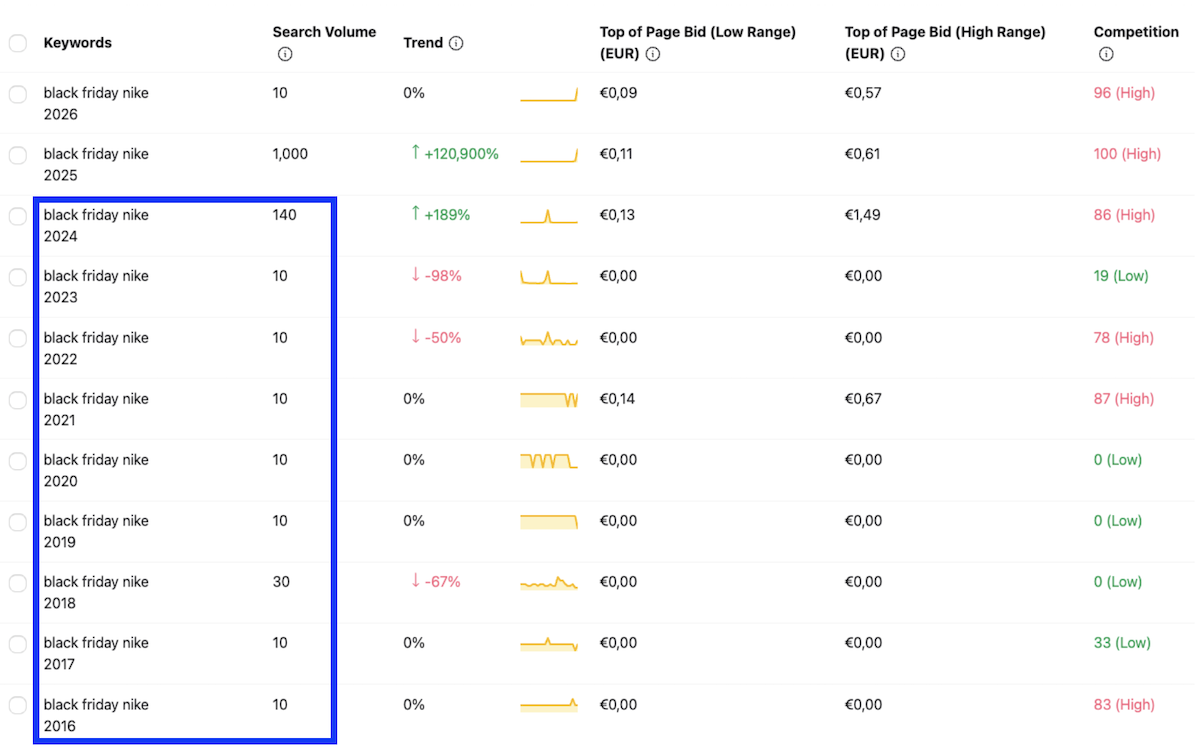
Backward searches are residual, except for 2025, which is the year that has just ended.
To answer the second question, we can use Google Trends and observe various trends.
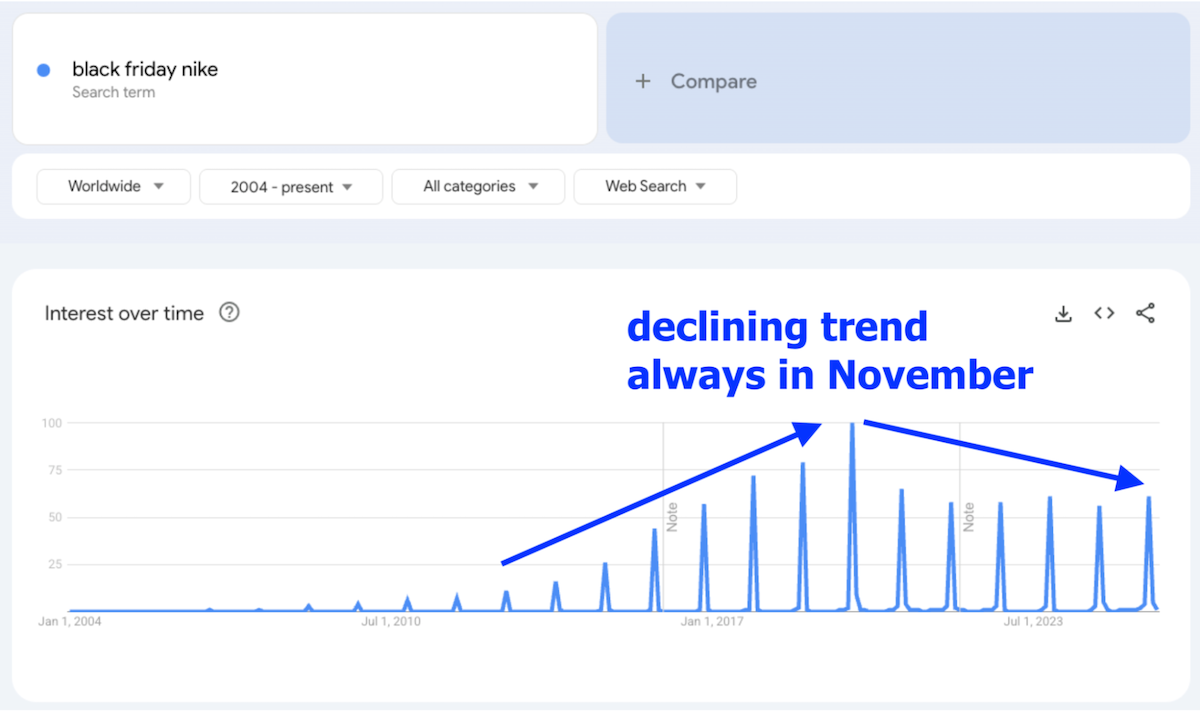
Overall, the trend since 2019 has been declining. In particular, interest begins to pick up starting in the summer.
Therefore, the first time we want to work on our seasonal campaign, we will need to be indexed before summer.
What obstacles might we encounter?
At the business and product level, there may be reluctance to show the catalog with Black Friday special offers so many months in advance.
Therefore, we will need to prepare content that can help us get indexed before searches explode and, as the date approaches, update the products.
Once the Black Friday event is over, we can start preparing the page for next year's event, without rushing. The most important thing is to keep the page indexed and give it the prominence it needs before searches start for next year.
In summary:
- We do not use the year in the URL.
- We index before searches explode.
- We re-index with the final content prior to the exact day.
- Once the date has passed, we remove the link, but we do not de-index.
- Before searches for the following year explode, we optimize the page with the new year, relevant content, etc.
- And so on every year.
Special Content Hubs
We can host certain hubs of special content related to seasonality or campaigns associated with a specific date. Some examples are:
- Sales
- Gifts
- Black Friday
- Valentine's Day
- Christmas
It is interesting to identify, first of all:
- Whether searches occur on an evergreen basis but then have a peak or surge
- Whether searches only occur at a specific time
Continuing with the Nike example, we can see the general evolution:
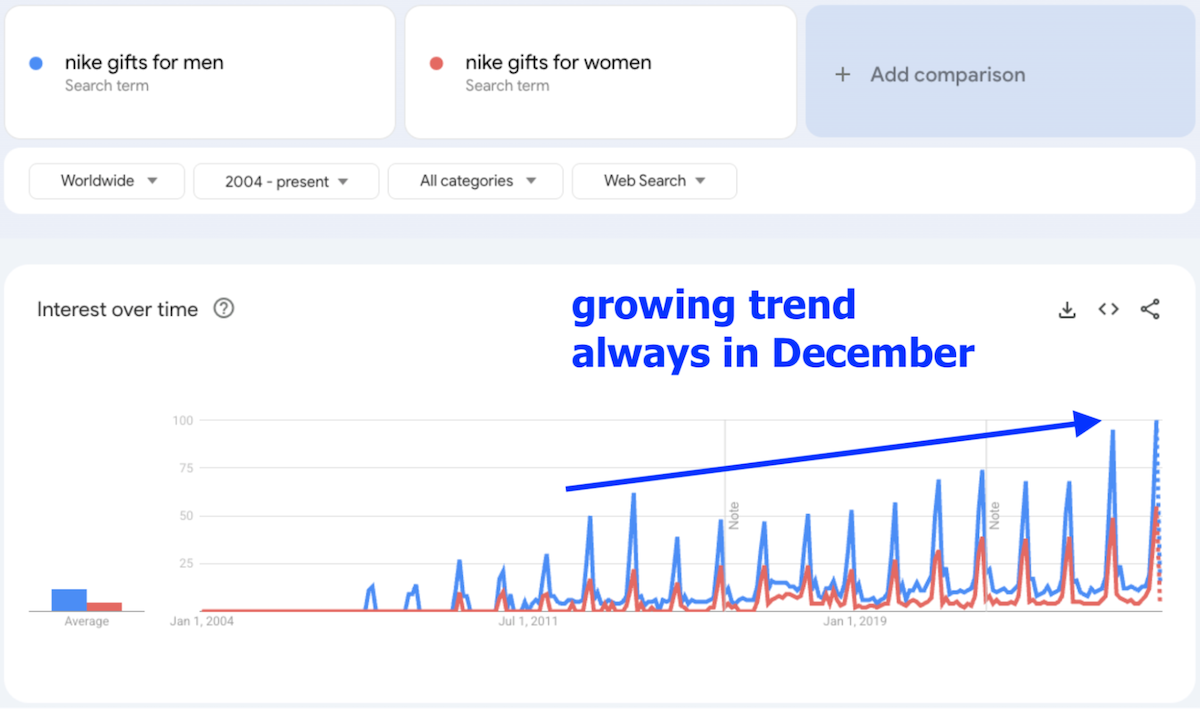
The trend is growing, both for men and women, with very marked seasonality.
If we now zoom in on the last year, we can extract more insights:
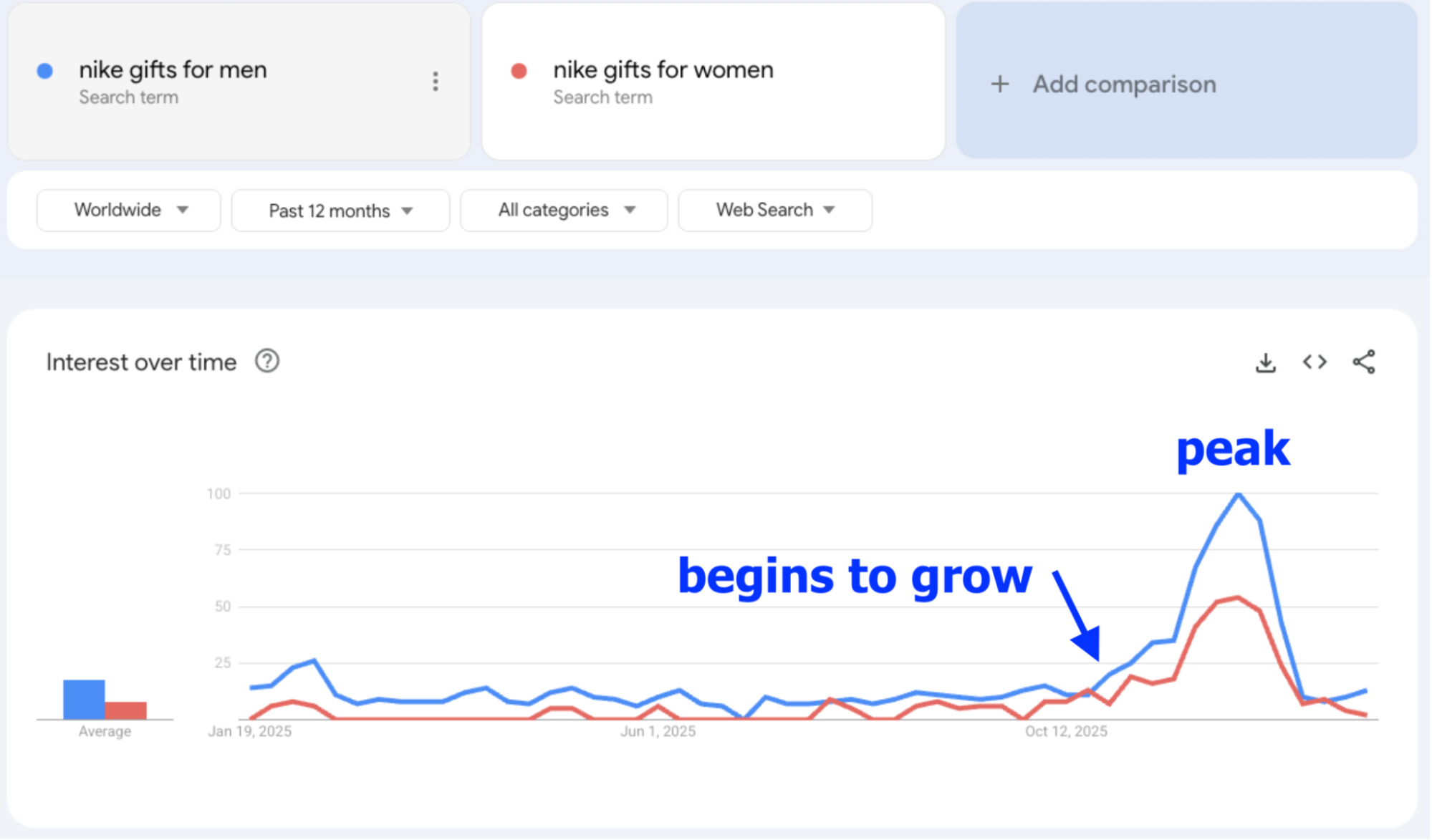
There is an evergreen but residual search trend throughout the year, which increases after September and peaks in November and December. These are the months when Black Friday, Cyber Monday, and Christmas all coincide.
What does this tell us?
We should definitely have our gift hub available all year round, although we should give it more prominence in the last quarter of the year.
Some keys to creating it:
- Identify the demand that exists for your gift-related project.
- Less is more. Do not create pages for small volumes. It is preferable to group and create a more consistent structure that can be maintained, using pillar pages or clusters.
- Linking is winning. Yes, in 2026, it will still be one of the foundations of success.
Out-of-Stock Management
Without a doubt, this is one of the major "SEO challenges" faced by online stores, putting their strategy to the proof and testing whether it is above and beyond their tactics.
Creating systems is a decision that goes beyond creating isolated implementations or actions.
Let us look at what to focus on when a product is out of stock, through several possible solutions.
Keep the page active (for temporary stock)
- Recommended when the product will be back soon.
- Keep the URL, clearly show that it is out of stock.
- Use availability schema to indicate the current situation.
- Keep useful content (photos, descriptions, related products).
Advantages: You retain authority, links, traffic, and rankings.
When to use it: Short restocking times.
Redirect the page (for long transitions or replaced products)
- 301 permanent: to the equivalent category or product.
- 302 temporary: if you plan to restock but in the long term.
Advantages: You can transfer authority to relevant URLs.
Caution: Ensure that the destination page is truly equivalent so as not to confuse the user or Google.
Delete the URL (when it has no SEO value)
- Use a 404/410 if there is no intention to restock and there are no relevant searches.
- Update internal links to avoid unnecessary 404 errors.
Result: Indexing clean-up, but you lose accumulated SEO signals.
When: Products with no visit history or links and no intention of restocking.
How to pick an approach
Before deciding, check:
- Does the page receive organic traffic?
- Does it have external or internal inbound links?
- Is there search intent related to this product?
If yes to the above → look at options to keep or redirect and reuse authority.
If no → consider deleting or no-indexing.
Remember that activating a permanent redirect by default for any product, whether it's out of stock or will never be back in stock, can cause tracking and crawl budget consumption issues if your project is large.
In addition, this will cause many unindexed pages to appear in your Google Search Console, so keep this in mind before making your decision.
"Coming Soon" Page Management
Launches are a different case, especially when these products already have naturally generated hype in the sector and users are waiting for the day to buy.
A characteristic sector for this is trainers, where special models are periodically launched that are exclusive designs or reissues of retro models, generating a great deal of excitement on social media, sometimes even starting with rumors that never materialize.
The biggest obstacles in these situations:
- If you are a distributor, you depend on the brand to provide you with materials to promote the product before you have the product and the sales page.
- You may not have all the final official details, so you should consider dividing the indexing into several phases.
Once rumors of launches begin to circulate, websites start publishing and updating their calendars. For example, it is already known that in February and March, several models that are in high demand will be launched, such as the collaborations with Off-White.
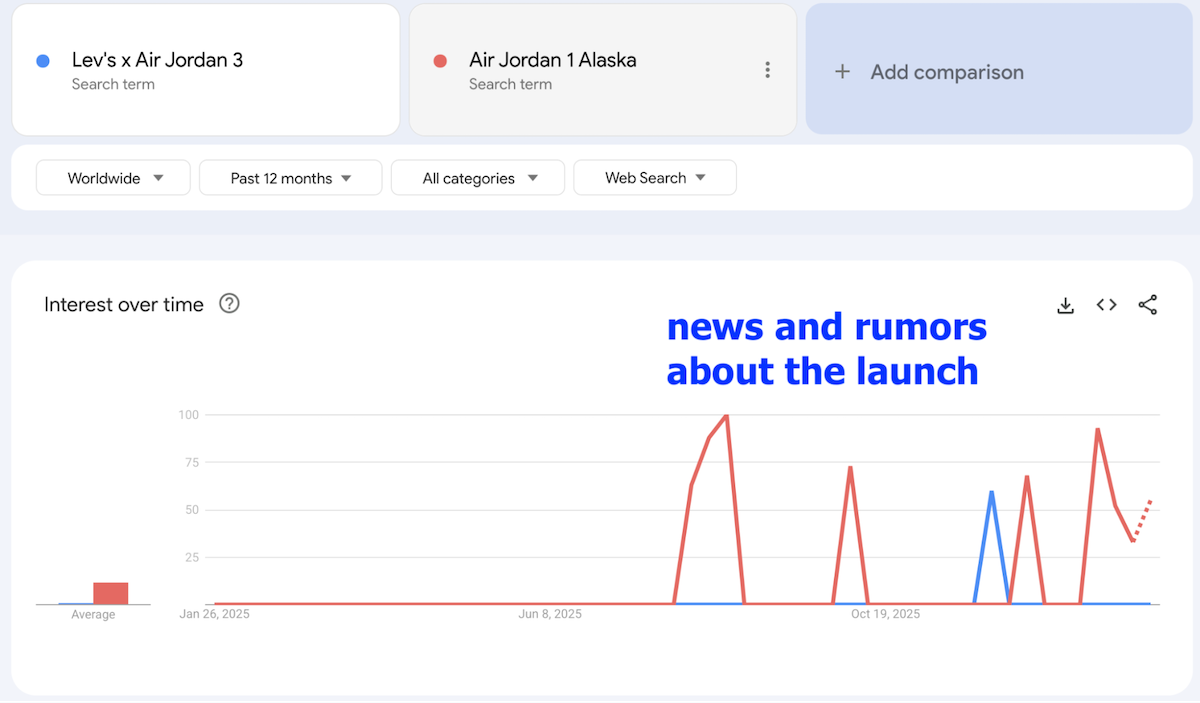
The roadmap should be:
- Page with information about the shoe, photos and price, if possible, without a purchase link. If you have the images later, index the newest ones.
- Social media posts with a link to the shoe information page.
- Generation of content that supports the main shoe information page.
- When the sales or raffle link is available, update it.
- On launch day, a virtual queue service is usually enabled to manage access, so there will be temporary redirects to the contracted service.
The important thing to know is that the ranking for this type of launch is not concentrated on the day it goes on sale, but rather you have to try to be positioned before it is announced that it will be on sale.
In this case, information and even rumors are power.
There is no single ideal strategy here; it is one of those situations where everything depends on the specific circumstances of the project and the agreements with suppliers and third parties. Look for the simplest and most systematic solution.
8. Measurement and Continuous Improvement
As everyone knows, "if you can't measure it, you can't improve it." We have a responsibility to properly monitor how our project is progressing so that we can incorporate improvements or corrections when appropriate.
Furthermore, we now have to do so with an understanding of the current situation:
- Some of the objectives are based on keyword rankings.
- Some of the objectives are based on mentions or citations of keywords or prompts.
- Some of the objectives are based on platforms that are not traditional search engines.
Tools
- Google Analytics 4 (GA4): allows you to analyze organic traffic behavior, conversion, revenue, and the real impact of SEO on your business.
- Google Search Console (GSC): we can measure visibility on Google with metrics such as clicks, impressions, CTR, average positions, indexing, and coverage.
- Third-party SEO tools (Ahrefs / Semrush / SISTRIX): useful for tracking rankings, analyzing competition, studying demand and detecting opportunities, popularity, and now also incorporating visibility in AI.
- Audit tools (Screaming Frog, Sitebulb): essential for monitoring technical hygiene, traceability, indexability, content, and metadata.
- Performance tools (DebugBear, Page Speed Insights, Lighthouse)
- Log analysis: key to understanding how Google and AI robots crawl the site, which URLs they prioritize, and where crawl budget is wasted.
YouTube, Instagram, and TikTok all have their own statistics panels, like administrators, which allow you to extract better insights after analyzing the content pieces.
KPIs
We can differentiate between several types of KPIs in order to customize the e-commerce project we are working on, starting with more general or global KPIs:
- Organic Revenue: Revenue generated by organic traffic.
- Organic Conversion Rate: Percentage of organic sessions that end in conversion.
- Organic Traffic Growth: Evolution of the volume of organic sessions.
- CTR & Impressions (GSC): indicators of snippet efficiency and alignment with search intent.
- Engagement Rate / Bounce Rate: signs of quality of experience on key pages.
Continuing with other KPIs more focused on crawling and indexing:
- Index Coverage KPIs (GSC): monthly evolution of valid vs. excluded URLs, evolution of errors, monthly evolution of discovered unindexed pages, monthly evolution of crawled unindexed pages, monthly evolution of indexed pages by sitemap.
- Crawl KPIs (Server Logs): crawl frequency, distribution by page type, ratio of crawled vs. indexed URLs, ratio of crawled non-indexable URLs (noindex, canonicalized).
Regarding KPIs related to ranking, including AI Overviews:
- Keyword Rankings by Intent: monthly evolution of rankings for transactional, commercial, and informational keywords.
- Top 3 / Top 10 Share: distribution of keywords in critical positions, separating transactional information, above all.
- Ranking by Segment: tracking by categories, brands, lines of business, or semantic territories.
- AIO Appearance Rate: percentage of top 100 keywords that trigger AI Overviews.
- AIO Top 10 Appearance Rate: percentage of keywords in the top 10 that trigger AI Overviews. Helps identify risk of click loss and citation opportunities.
- Share of Mention AIO: frequency with which the brand is mentioned in AI Overviews for a set of target keywords.
- Share of Citation AIO: number of times the ecommerce URL is cited as a source in AI Overviews.
If we are going to try to create a set of KPIs based on LLMs:
- LLM Share of Mention: frequency with which the brand is mentioned in responses generated by LLMs for a set of prompts or queries representative of the sector.
- Sentiment of Mentions: qualitative analysis of the context of the mention (neutral, positive, comparative)
- LLM Share of Citation: number of times the domain is explicitly cited as a source in LLM responses.
- Citation Type: try to differentiate between direct citation (explicit URL) and implicit reference (paraphrased content without a link). This may be relevant for evaluating visibility without clicks.
It is important to note that all these KPIs can then be broken down into brand vs. non-brand, and also based on key segments defined by the business. For example, if we are a sports e-commerce site, we can segment by sport, brand, gender, or product type.
I have deliberately omitted adding YouTube or TikTok metrics so as not to make the article any longer, but if you are interested, we can discuss it in the comments :)
Finally, when it comes to AI and LLMs, in terms of monitoring prompts, we are playing with a handicap that we cannot control: the prompts made by users are not public, and we do not have that information to know how they search and track.
The concept of "potential prompt" or "synthetic prompt" arises in this context and can be useful as a starting point, but without cutting ourselves off from reality and common sense. Let's not turn an approximation or estimate into a forced reality just to comply with trendy metrics.
Recurring Audits
Beyond conducting specific audits, the aim is to work on systems that enable the monitoring and prevention of potential errors, as well as the best possible management of the SEO project:
- Real-time alert systems: implement automatic alerts to detect drops in rankings or traffic, indexing errors, crawling issues, Core Web Vitals variations, or unexpected changes in visibility. Example: littlewarden.com
- SEO sprint work: organize SEO into short, recurring cycles to review key KPIs, validate hypotheses, apply corrections, and measure results in an iterative and controlled manner.
- Periodic site crawling: perform regular crawls to maintain continuous control of the SEO status of the e-commerce site, identifying errors, technical incidents, other shortcomings, etc.
- Shared monitoring dashboards: centralize key metrics in dashboards accessible to SEO, facilitating alignment between the teams involved.
- SEO planning aligned with the business: define an annual SEO plan that considers critical milestones such as catalog changes, seasonal campaigns, launches, or migrations, allowing you to anticipate impacts and plan ahead.
CRO and SEO Integration
Integrating SEO and CRO is the strategic combination of disciplines that allows you to maximize your visibility efforts in order to efficiently and effectively convert them into business.
In e-commerce with a certain volume of traffic, conversion improvements can already be identified and segmentation can be used to propose different experiments before implementing changes.
When both teams work together, templates improve, become faster and clearer, and are more intention-oriented, resulting in the winning combination: better positioning and higher conversion.
In times when the ways of attracting customers are being redefined, whether it is through traffic, visibility, the ability to be mentioned by AIs, or capturing attention with videos that promote the product, SEO+CRO synergy comes into play in all these possibilities.
Monetizing every user who visits the e-commerce site is one of the most impactful strategic keys.
Conclusion
There's a lot to keep in mind when optimizing your online store. You don't have to start out perfect, but can instead take a gradual approach, making sure that search engines can find and understand your content and that visitors have a good experience.
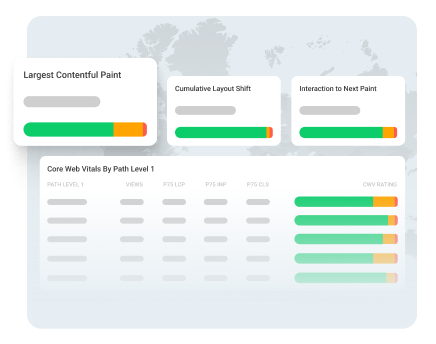
If you're working on your Core Web Vitals, give DebugBear a try. We provide comprehensive web performance monitoring insights, helping you not just fix Core Web Vitals issues but also stay fast long term.
Monitor Page Speed & Core Web Vitals
DebugBear monitoring includes:
- In-depth Page Speed Reports
- Automated Recommendations
- Real User Analytics Data